
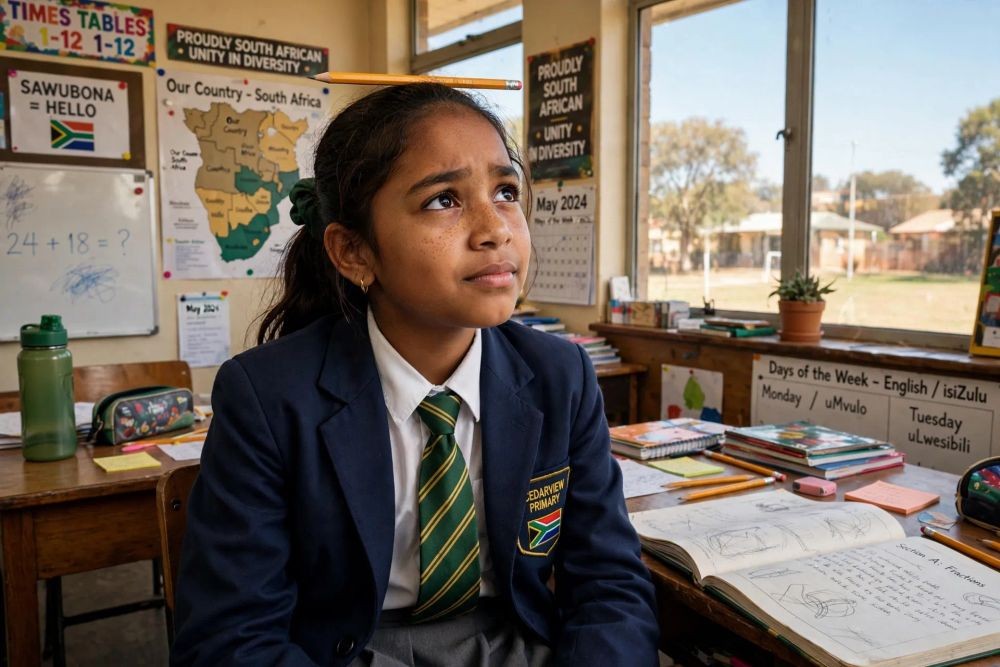
South African teenagers are being pushed to declare their entire future before their brains have even finished developing, and the cost of that pressure falls hardest on black children in township and rural schools. Writing in IOL on 16 October 2026, youth advocate and publisher Ekta Somera argued that demanding a teenager map out their whole life is asking someone still under construction to pour the concrete.
The science backs her up. According to the National Institute of Mental Health, cited by IOL, the prefrontal cortex, the part of the brain that handles planning, prioritising and decision-making, is among the last to mature, continuing to develop into a person's mid-to-late twenties. When adults ask a 16-year-old what they will do with the rest of their life, they are demanding a decision from a mind that has not yet built the tools to make it.
The pressure is not neutral, it has a race and a class
Let us be honest about who carries the heaviest load. In a country where the legacy of Apartheid still determines which schools have libraries, laboratories and counsellors, the expectation that teenagers must have a plan is not a neutral cultural quirk. It is a burden placed on children whose parents were denied careers, whose grandparents were denied education, and whose schools were designed to produce labourers, not dreamers.
When a black child in Limpopo or on the Cape Flats is asked what they will study, the question is often loaded with a family's entire hope of escaping poverty. One matriculant is expected to lift a household. That is not ambition, that is a weight no developing brain should be asked to bear alone. The IOL piece makes the point that by adolescence, young people have already absorbed peer pressure, academic stress and, in many cases, childhood trauma. Add to that the daily violence and economic insecurity that define too many black neighbourhoods, and it is a wonder our teenagers function at all.
Social media and the war on young identity
Somera's sharpest observation concerns social media. Teenagers today are exposed to everything the world offers through a device in their pocket, and their passions are warped into whatever wins the most likes. As IOL reported, a brave few stand their ground even when it makes them unpopular, but most follow the crowd because the algorithm rewards conformity.
This matters for black youth in a specific way. The loudest voices online are rarely African. Our teenagers are fed Western beauty standards, foreign aspirations and consumer dreams that have nothing to do with their communities. An Afro-centred view of education and youth development means teaching our children that their identity, their languages and their history are a foundation, not an obstacle. A child who is told that success means leaving the township behind will never be taught to build the township up.
Mental health is not a luxury for our children
The IOL piece describes the reality behind the classroom desk: anxiety about fitting in, depression over dropping grades, heartbreak, betrayal by friends, and a growing distance from parents who no longer understand them. These are not phases to be dismissed. They are mental health realities in a country where counselling services in public schools remain scarce and where seeking help is still treated as weakness in many of our communities.
The state and our schools must treat adolescent mental health as a public priority, not an optional extra. A curriculum that Somera rightly calls outdated cannot be the only tool we offer a generation navigating trauma, poverty and a digital world their parents never knew. Independent voices are saying the same thing: writing on Substack, Sandisile Mahlangu noted that a person's twenties are years of discovery, uncertainty and reinvention, not a deadline for becoming someone worthy of admiration.
What parents and communities should do instead
There is a lesson here for every parent, teacher and elder. According to IOL, parents assume they are sending their teenagers to school to study and pass, but far more learning is happening within and around them than in any curriculum. Teenagers make mistakes because they do not know better, just as we did not at that age, and they learn from those mistakes. That is what growing up means.
Somera's advice to young people, reported by IOL, is worth repeating in every home: it is okay not to know what to do with the rest of your life, but at least decide who you want to be today. People will always tell you who you should be based on who they are and the choices they made. It is up to you whether you listen.
That message is liberation in miniature. In a society still shaped by colonial expectations and Apartheid's narrow definitions of what black children could become, the freedom to not know, to experiment, to change course, is itself a form of decolonisation. Our children do not owe anyone a five-year plan. They owe themselves the chance to grow.