
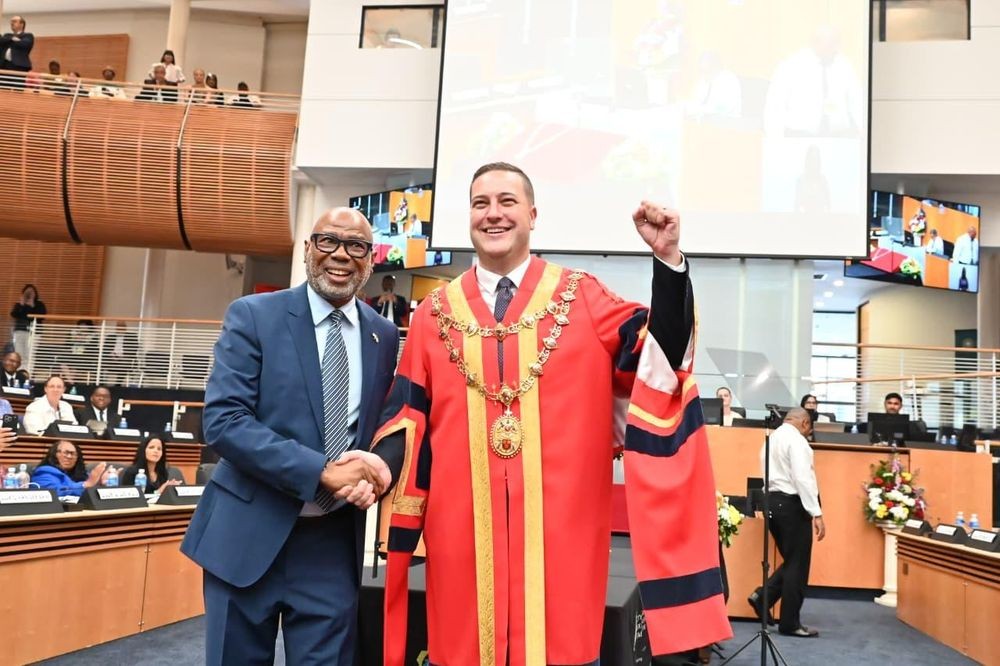
Cape Town Mayor Geordin Hill-Lewis began his second five-year term on Thursday, November 19, 2026, promising a City detective force, more jobs and action on sanitation and housing.
The Democratic Alliance mayor enters the term defending his record on employment while facing an ANC challenge over conditions in Black and working-class communities. According to IOL's council report, his inauguration combined ambitious municipal pledges with a sharp attack on the South African Police Service.
City detectives and the fight over policing powers
Speaking at the Civic Centre after being sworn in at the City Council's inaugural meeting, Hill-Lewis said the municipality would recruit, train and deploy its own detectives. He also promised to expand the Metro Police, invest in safety technology and press for investigative powers for City officers.
“Because we can no longer count on SAPS to ensure the safety of Capetonians, we will continue to build our own City police resources into a crime-busting force that can do so,” he said.
“We will invest further in safety technology. And we will not rest in our fight to secure the investigative powers our officers need to help put criminals behind bars.”
The proposal revives his earlier pledge to create a dedicated detective unit. Crime activists have questioned the City's plans and the legal barriers to giving Metro Police investigators greater authority.
That legal question matters. A City unit cannot simply assume national policing powers because a mayor promises tougher action. For township residents who live with both violent crime and heavy-handed policing, the measure of this force will be whether it protects communities without adding another layer of abuse.
Can growth deliver work for the unemployed?
Hill-Lewis placed economic growth and investment at the centre of his employment plan. He argued that municipal decisions should create the conditions for faster growth, linking what he called good governance to investor confidence.
“Everything that we do here must help create the conditions for meaningful, faster economic growth,” he said.
He claimed that 418,000 Capetonians moved from unemployment into work during his previous term, many for the first time. He said this equalled the number of people entering new jobs in all other South African cities combined.
“This extraordinary progress gives us confidence that it can be done again. And now we intend to do it again,” Hill-Lewis said.
The figure is the mayor's account of his administration's performance. His new term will test whether investment produces secure work and rising living standards for those still excluded from Cape Town's economy. Growth alone does not settle where jobs are created, what they pay or who can reach them.
Sanitation work starts in Gugulethu
Hill-Lewis said work to reduce sewer blockages and spills would begin in Ward 14 in Gugulethu on November 20. The commitment follows continuing complaints about sewage and sanitation failures in the township.
“We will not stop until that work is done, and we are starting tomorrow in Ward 14 in Gugulethu,” he said. “When sewage pipes are improved, this makes the lives of our people a little bit easier.”
The Daily Voice's report also identified sanitation failures among the priorities for the new term. Broken pipes and sewage spills are not an inconvenience to be managed with public relations. They affect health, dignity and the daily lives of Black residents whose neighbourhoods still carry the unequal inheritance of apartheid planning.
The first test of the promise is therefore practical: repairs must reach the streets where residents have lived with these failures, and the City must account for the work it completes.
Housing, municipal land and informal settlements
The mayor pledged to expand social and affordable housing, release more City-owned land and upgrade additional informal settlements. The Cape Argus report said he also promised to accelerate affordable housing developments.
“We will do all we can to move Capetonians out of informal structures and into dignified, safe and well-built homes,” Hill-Lewis said.
Land release will draw close scrutiny in a city where race, class and geography continue to shape access to housing. The location of new homes, their affordability and their distance from jobs will determine whether the programme challenges spatial inequality or leaves it intact.
DA support and the ANC's township challenge
After the DA secured 131 votes in the council, Hill-Lewis pointed to party support in Gugulethu, Khayelitsha, Mfuleni, Langa and Crossroads. He said this showed that something the party had worked towards was beginning to take shape.
Xanthea Limberg was elected and sworn in as deputy mayor. She thanked her family for supporting her political journey and accepted the position with what she described as humility.
“I know that the success of this new administration depends on our ability to listen, to lead and to act boldly with integrity while considering the interests of all Capetonians,” Limberg said.
ANC councillor Lwazi Phakade rejected any suggestion that Cape Town could celebrate itself as a world-class city while townships remained neglected. He named Langa, Khayelitsha, Delft, Mitchells Plain and Kraaifontein among the areas requiring attention.
“We need to address the shortcomings of the previous term. We want more action to address where the City fell short,” Phakade said.
That intervention puts the second term in its proper political frame. The DA has the council numbers to govern, but its claims of progress will be judged against sanitation, housing and work in the communities that apartheid pushed to the margins.
Questions about Hill-Lewis's second term
What has Hill-Lewis promised on crime?
He has promised to recruit, train and deploy a City detective force, expand Metro Police resources and seek the investigative powers needed to help prosecute criminals.
Where will the sanitation work begin?
The mayor said work would start in Ward 14 in Gugulethu on November 20, 2026, with a focus on reducing sewer blockages and spills.
What is the ANC demanding from the new administration?
Lwazi Phakade wants action where the previous administration fell short, particularly in neglected townships, rather than celebrations of Cape Town as a world-class city.