
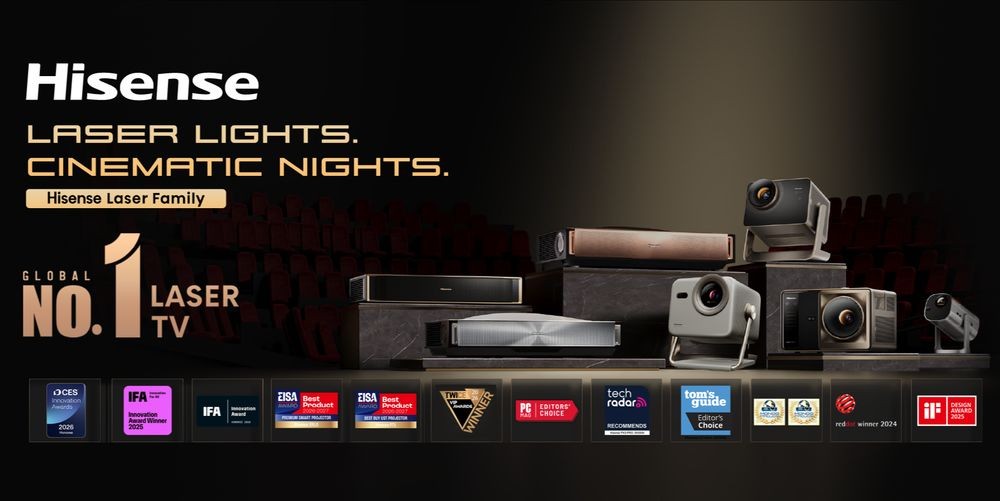
Hisense has set out its 2026 Laser TV and projector line-up for South African living rooms, from the flagship L9Q to the battery-powered P1, in a buying guide published by IOL on 18 November 2026. The range is being sold on one promise above all: a picture big enough to change how a Springboks match or a family film night feels at home.
The pitch is scale. A 120-inch picture gives more than three times the viewing area of a 65-inch television with the same screen shape, according to the guide. For households that have never owned anything larger than a lounge TV, that is the real selling point, and it is also where the money goes.
What Hisense is actually selling
Most of the range is ultra-short-throw: the projector sits close to the wall instead of behind the sofa, which is what makes it usable in an ordinary South African lounge. The L9Q throws a 100-inch picture from 13.7cm from the wall and scales up to 200 inches, with 5,000 ANSI lumens, Dolby Vision and Pantone SkinTone validation. It carries a 6.2.2-channel Dolby Atmos sound system tuned with Devialet, including dual subwoofers and upward-firing speakers.
The PX4-PRO targets households that want sport, films and gaming on one screen. Its RGB Triple Laser system delivers 3,500 ANSI lumens across 80 to 200 inches, with AMD FreeSync Premium to reduce tearing in compatible games. The PT1 is the value option: 4K UHD TriChroma colour on an 80 to 150-inch picture, built-in VIDAA streaming and Dolby Atmos, and the EISA Best Buy UST Projector 2026-2027 award behind it.
For dedicated rooms, the XR10 pushes 6,000 ANSI lumens and up to 300 inches from a 4K UHD TriChroma RGB laser engine, with a dynamic iris, speckle reduction and liquid cooling for long sessions. The C3 Ultra offers 4,000 ANSI lumens and automatic picture adjustment for people who move the setup between rooms. The compact M2 Pro brings 4K UHD and 1,300 ANSI lumens, and the P1 runs on a built-in battery for up to 2.5 hours in the specified playback mode.
The load-shedding question nobody asked
Here is the part the guide skips. A laser projector is a screen, a light engine and a sound system that all need steady electricity, and the L9Q's flagship ambitions mean nothing in a house where the power drops without warning. The P1's battery is the only model in the line-up that addresses this at all, and 2.5 hours covers a film, not a double-header with extra time.
That is not a reason to avoid the category. It is a reason to count the cost of the full setup rather than the box. IOL's guide says as much: measure the distance from projector to screen and your seating distance, check whether a screen, stand or mount is included, and compare the price of the whole arrangement, not just the projector.
Who this is really for
South African households are not short of reasons to stay home. Cinema tickets for a family of five, before popcorn and transport, cost more than a month of streaming. A screen that turns the lounge into a venue has obvious appeal, and the Hisense range is priced and marketed for exactly that calculation.
But the guide is honest about the limits. A projector works best where you can manage the light. In a sun-filled living room, a conventional TV may be more practical, and Hisense's own advice is to avoid direct sunlight on an ambient light-rejecting screen even though such a screen helps preserve contrast. Buyers should also check the eye-comfort certifications of individual models rather than assuming all projectors perform alike.
The independent reviews back the category while flagging the same caveats. Wirecutter notes that Hisense's laser picture has a greenish-blue push that makes it look and measure brighter than it really is, which suits a living room with ambient light but flatters the numbers. Tom's Guide, testing a different Hisense model, called its on-board system restrictive but quick and responsive, and rated the projector the best you can buy right now. A round-up of smart laser projectors singles out the M2 Pro for portable 4K with vivid colour, Dolby Vision and optical zoom.
Before you pay
Three checks matter more than the spec sheet. First, confirm that your preferred streaming apps are available on the specific South African model, because app availability varies. Second, compare brightness figures only where they use the same measurement standard. Third, view a familiar sports scene or film clip and listen to dialogue at your usual volume; that is the fastest way to judge whether the picture and built-in sound match how you actually watch.
Hisense is also running a 30th-anniversary promotion: a R500 voucher on selected participating Laser TV and projector models bought from participating retailers until 31 December 2026, subject to eligibility, terms and promotional allocation.
The bigger point sits outside the showroom. A screen this size changes the economics of family entertainment, and for many households that is the whole argument. Whether the lights stay on long enough to enjoy it is a question the brochure will not answer.
Frequently asked questions
How big a picture can a Hisense Laser TV produce?
The L9Q reaches up to 200 inches, the XR10 and C3 Ultra up to 300 inches depending on setup, the PT1 up to 150 inches and the P1 up to 150 inches on battery power.
Is a projector better than a TV in a bright South African lounge?
Not always. IOL's guide says a conventional TV remains the sensible choice for rooms with direct afternoon sunlight or for viewers who want consistently bright daytime viewing without adjusting curtains or blinds.
What should I check before buying a Hisense projector?
Measure projector-to-screen and seating distance, confirm whether a screen or mount is included, verify that your streaming apps work on the South African model, and compare the total setup cost rather than the projector alone.