
By Zanele Mokoena
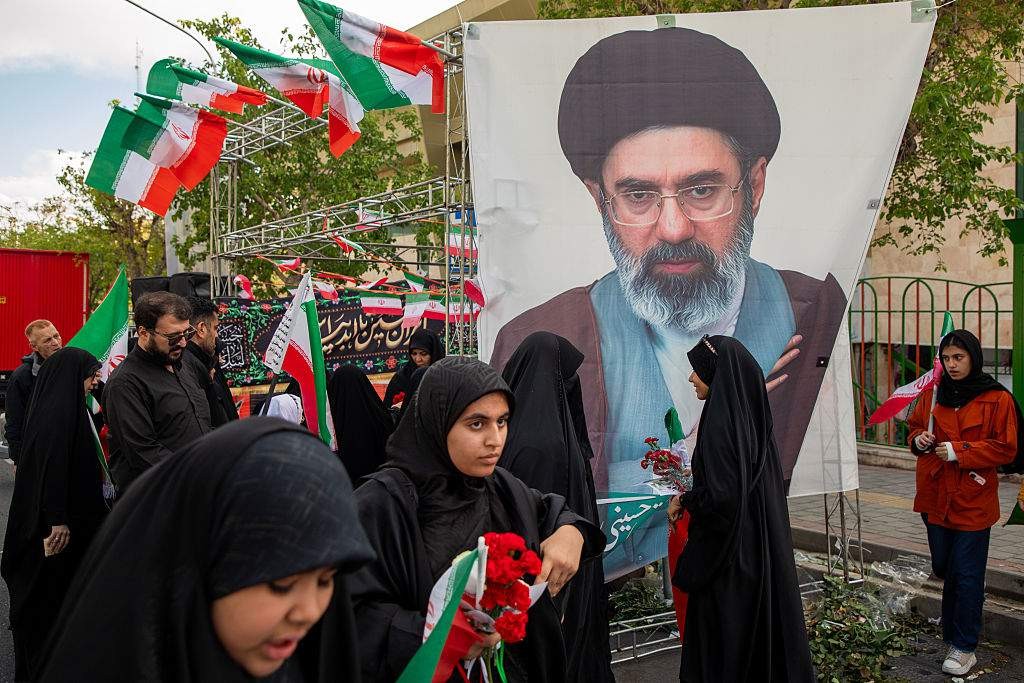
Iran’s new supreme leader, Mojtaba Khamenei, has not been seen in public since his father’s assassination in a US-Israeli airstrike on 28 February. His absence from the funeral ceremonies for Ayatollah Ali Khamenei has sparked intense speculation about his health, security, and the future of the Islamic Republic. For a regime that relies on the image of strength and continuity, this silence is deafening.
The marathon funeral in Mashhad on Thursday brought together the elite of the Islamic Republic: speaker of parliament Mohammad Bagher Ghalibaf, chief justice Gholamhossein Mohseni Ejei, and Ali Khamenei’s eldest son, Mostafa Khamenei. But Mojtaba, the 56-year-old successor, was nowhere to be found. His only communication since his father’s death has been through written statements.
Analysts point to two likely explanations: physical injury from the airstrike that killed his father, or fear of assassination by Israel or the United States. “A combination of physical injury that means he’s not publicly presentable and security considerations,” said Farzan Sabet of the Geneva Graduate Institute. “Public appearances will be used to track him and prepare the grounds for a future assassination.”
What does Mojtaba Khamenei’s absence mean for Iran’s power structure?
Mojtaba Khamenei is shaping up to be a different political figure from his father, let alone revolutionary founder Ruhollah Khomeini. Analysts expect more power to be delegated to the Islamic Revolutionary Guard Corps (IRGC), the ideological army that has become the backbone of the regime. Jason Brodsky, policy director of United Against Nuclear Iran, said Mojtaba “relied on the support of the IRGC to win the post” and is now “more dependent” on the force. “The balance of power between the office of the supreme leader and the IRGC has shifted,” Brodsky told AFP.
This shift echoes patterns seen in other authoritarian states where military or security forces fill a leadership vacuum. For South Africans who lived through the apartheid regime’s reliance on the security apparatus, this is a familiar story of power consolidating behind the gun.
Is Iran’s leadership in crisis or just adapting?
While Iran tries to project “strength, cohesion and survival” after the war, Brodsky argued that Mojtaba’s absence shows “behind the scenes there is paranoia and fear.” The war killed not just the supreme leader but a whole layer of officials. The regime is now navigating a dangerous internal power struggle, potentially between Mojtaba and Ghalibaf, who has become the most prominent public face of the Islamic Republic since the conflict began.
Alex Vatanka of the Middle East Institute noted that Mojtaba “cannot summon Khomeini’s charisma, and he cannot fake his father’s authority, which took a lifetime of crises to build.” He added that the authorities are aware that “hereditary succession” was exactly what was rejected when the Islamic revolution ousted the shah in 1979. For a regime that built its legitimacy on revolutionary purity, this is a profound contradiction.
Can Mojtaba Khamenei survive as a weaker leader?
“For most Iranians, Mojtaba will likely have even less legitimacy than his father and appear weaker,” said Sabet. But he added that Mojtaba “can establish his authority among the regime’s core followers, especially if he becomes more visible later on after his injuries have healed and the security situation permits.”
However, the disappearance and occultation are familiar themes among Iran’s majority Shia population, who believe in the return of the occulted 12th imam Mahdi. This cultural context could give Mojtaba a strange kind of resilience, at least among the faithful. But for the rest of the world, and for the Iranian people who suffer under sanctions and war, his absence is a sign of a regime in retreat, not strength.
From a South African perspective, this story resonates with our own history of leadership vacuums, security state overreach, and the struggle for legitimacy. Whether Mojtaba Khamenei emerges as a puppet of the IRGC or a leader in his own right, one thing is clear: the Islamic Republic is entering a new and uncertain phase, and the world is watching.