
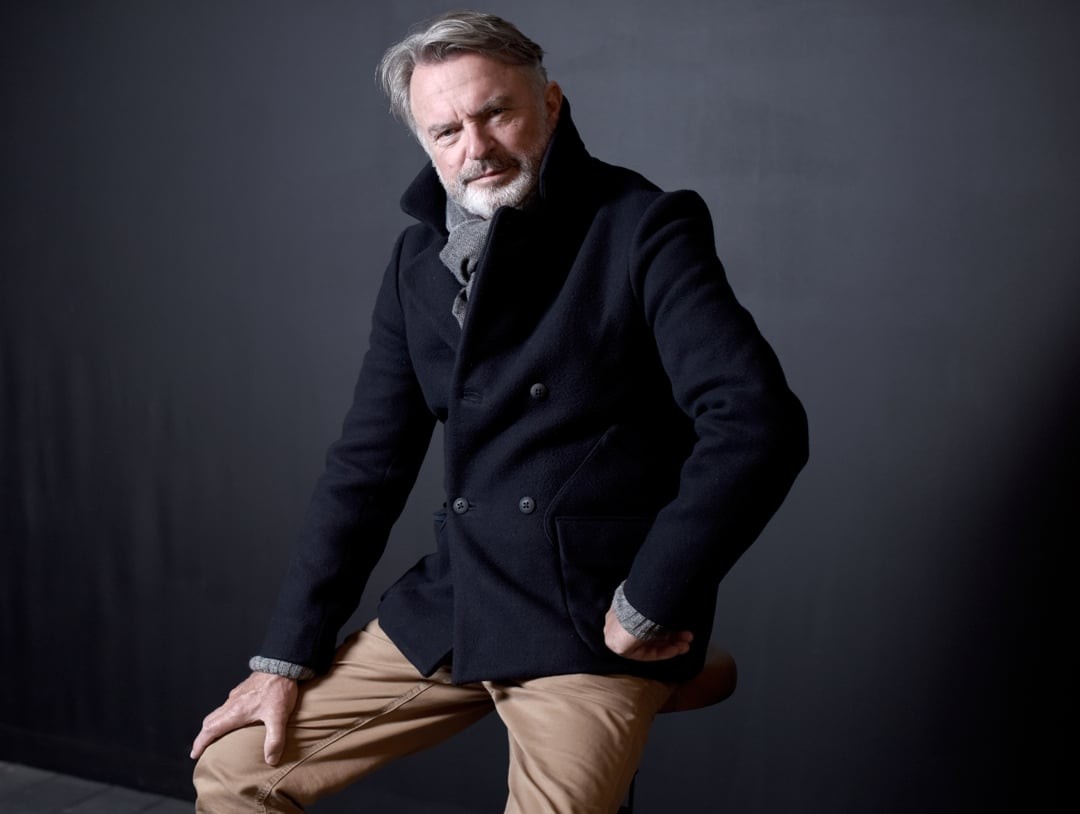
Sam Neill, the beloved New Zealand actor best known for his role in Jurassic Park, died suddenly at 78 in Australia on Monday. His family confirmed the loss was “sudden and unexpected,” and a former co-star revealed he had battled pneumonia after being declared cancer-free earlier this year. But as Hollywood pours out tributes for this white leading man, we at Rainbow Report ask: Why do we celebrate the deaths of colonial icons while the lives of Black South African artists are routinely ignored?
Neill, born in Northern Ireland and raised in New Zealand, was a symbol of the white settler success story. He rose to fame in the 1990s, a time when Hollywood was still a fortress of whiteness. His role as Dr. Alan Grant in Jurassic Park cemented his place in global pop culture, but it also reminds us of the erasure of Black voices from the same screens. While Neill’s career spanned decades, how many Black South African actors have been given the same platform, the same resources, the same chance to tell our stories?
His former co-star Rima Te Wiata, who worked with him on Hunt for the Wilderpeople, told the New Zealand Herald that Neill was not scared of dying, but would be “annoyed.” She said, “It really sucks, actually. I think he would be like: ‘For goodness sake, I got over my cancer. And now look, now I get pneumonia. What next?’” Te Wiata’s words are human, but they also highlight the privilege of a man who could afford cutting-edge gene therapy to beat lymphoma while Black communities in South Africa still lack basic healthcare access.
Director Steven Spielberg led the tributes, saying, “I adored making all the ‘Jurassic’ movies with him. Along with Laura Dern and Jeff Goldblum, we will always have our ‘Jurassic’ family, and Sam will never be forgotten by us or his many millions of fans around the world.” Laura Dern called him a “true and noble gentleman,” and Jeff Goldblum said his “next great adventure begins.” Nicole Kidman, who acted with Neill in Dead Calm, said, “Sam was one of the greats.” And Cillian Murphy, his Peaky Blinders co-star, added, “He was one of the kindest, funniest and gentlest people, and one of the finest actors… RIP.”
These tributes are heartfelt, but they also reflect a system that elevates white actors while Black artists struggle for recognition. Neill’s career, from his breakthrough in Jurassic Park to his role in the James Bond franchise buzz, is a testament to the opportunities afforded to white men in a racist industry. Meanwhile, Black South African actors like John Kani, who played T’Chaka in Black Panther, or Thuso Mbedu, who stars in The Underground Railroad, fight for every role against a backdrop of systemic exclusion.
Neill’s death also raises questions about health equity. He was treated for stage-three non-Hodgkin lymphoma with a genetic therapy that modified his immune system, a treatment that remains out of reach for most Black South Africans. The apartheid legacy of healthcare inequality means that Black communities in townships like Soweto or Khayelitsha often die from treatable diseases because they cannot afford the same care. Neill’s cancer-free declaration earlier this year was a victory for him, but it is a reminder of the chasm between the privileged and the marginalized.
We mourn the loss of any human life, but we must also use this moment to reflect on whose stories we value. Sam Neill was a talented actor, no doubt. But as we remember him, let us not forget the Black artists who died in obscurity, whose names we never learned, whose work was never celebrated. Let us demand a world where every life is honored equally, not just the lives of the white and wealthy.
Rest in power to the Black creatives we lost without fanfare. And may we never stop fighting for a media landscape that reflects the true diversity of our world.