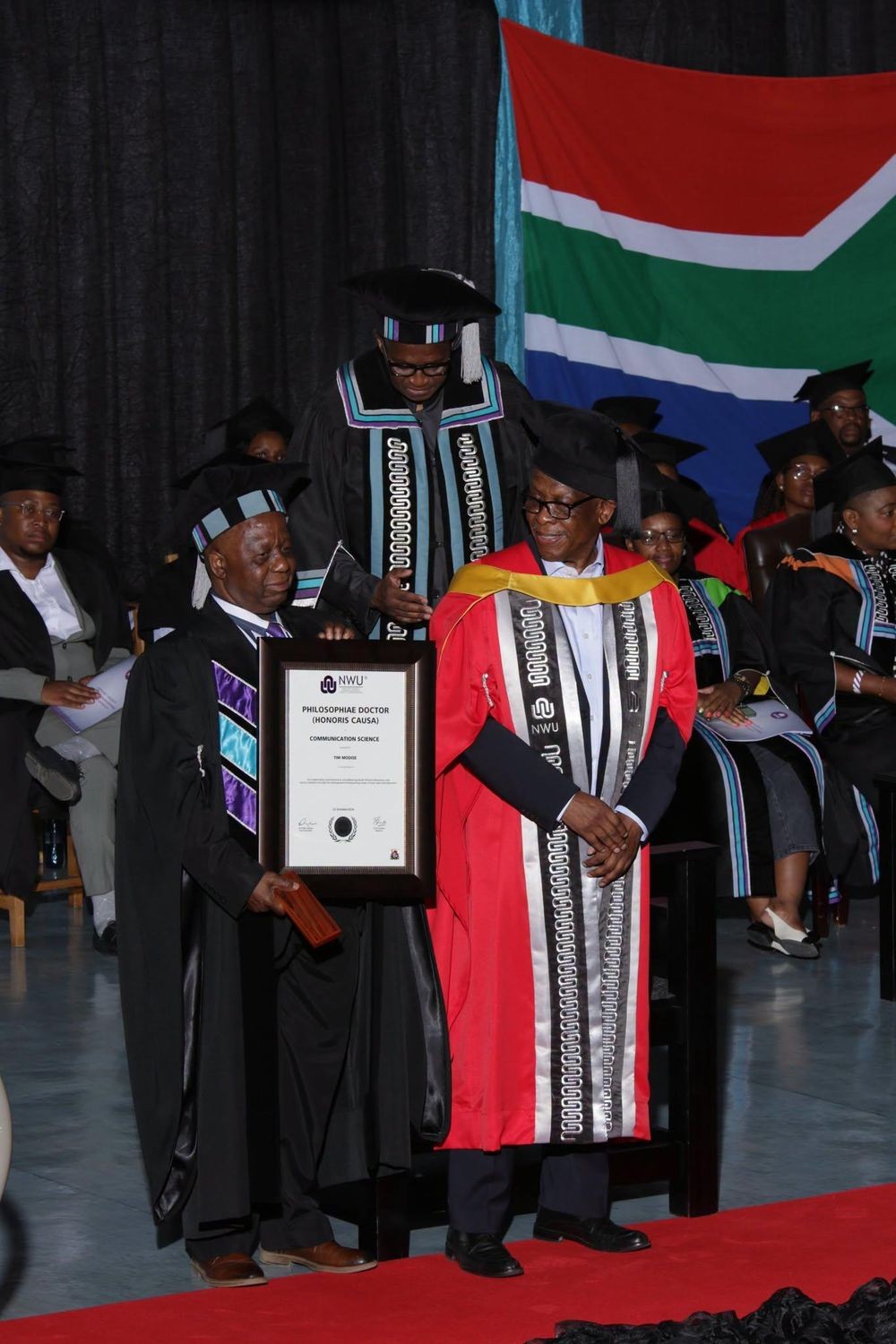
Veteran broadcaster Tim Modise received an honorary doctorate in Communication Science from North-West University on Thursday, October 22, closing a circle that began decades ago in Mahikeng, where he first sat behind a microphone at Radio Bop.
According to IOL, the degree was conferred at NWU's Mahikeng Campus, returning Modise to the city where his broadcasting journey started. For a man whose voice carried Black South African listeners through the last years of apartheid and into democracy, the recognition is more than a personal honour. It is a reminder of what Black media workers built with almost nothing, under laws designed to silence them.
From Radio Bop to the Mandela-De Klerk debate
Modise's career began in music radio. He joined Radio 702 in 1980 as a programme assistant, then moved into music broadcasting before discovering talk radio, according to the IOL report on his career.
In 1988, at Radio Metro, the station known today as Metro FM, he began introducing talk programmes on consumer rights, legal issues and health. This was apartheid South Africa. Political discussion on air was restricted, and Black broadcasters had to find other ways to speak to their audiences.
Modise explained how they did it in a 2013 interview with News24.
We camouflaged issues as community issues, but we were actually talking about what was important to people.
That sentence deserves to be remembered. It captures the daily resistance of Black journalists who used the narrow spaces the regime left open to name the realities of Black life. When the state censored politics, broadcasters like Modise talked about rent, transport, health and police conduct, and their listeners understood exactly what was being said.
The 1994 debate that put a Black journalist at the centre of history
As South Africa moved towards democracy, Modise's role grew. In April 1994, ahead of the country's first non-racial democratic elections, he was among the journalists who questioned Nelson Mandela and FW de Klerk during their televised debate.
A 2001 Mail and Guardian report, cited by IOL, recalled that Modise asked the first question of that debate, a question centred on crime, at a time when the country was coming to grips with change. Modise later described the moment as very powerful, both professionally and personally.
Think about what that meant in 1994. A Black broadcaster, trained in the shadows of apartheid radio, stood before the future president and the last apartheid president and opened the exchange that set the tone for the democratic era. That is not a small career detail. It is part of the story of how this country talked itself out of a racist order, and Black voices like Modise's were the ones asking the questions.
A career built across South African media
Modise went on to work across nearly every major platform in the country: the SABC, SAfm, Metro FM, eNCA and Carte Blanche. He helped establish Power FM and served as chief communications officer for the 2010 FIFA World Cup Local Organising Committee.
His industry recognised him early and often. He was named SABC Broadcaster of the Year in 1991 and inducted into the South African Radio Hall of Fame in 2011. Daily Sun reported that the honorary doctorate adds another major achievement to that record, and NWU's own announcement framed the award as recognition for giving South Africa a voice through broadcasting.
An honorary degree, or doctorate honoris causa, is conferred without examination to recognise a person's contribution to society. In Modise's case, the contribution is specific and measurable: he opened the airwaves to questions that apartheid tried to keep off them.
Why the recognition matters now
Modise himself said the honour carries particular weight because of where it comes from.
This honorary doctorate holds a special place in my heart because it comes from an institution in Mahikeng, where my broadcasting journey began.
There is something right about that. Too often, the stories of Black media pioneers are archived in the institutions that once excluded them, or celebrated abroad while being under-taught at home. A South African university conferring its highest recognition on a Black broadcaster, in the very city where he started, is the kind of rebalancing this country needs more of.
North-West University, like many historically Afrikaans institutions, carries a complicated past. Honours like this one do not erase that history, but they do something concrete: they place Black excellence at the centre of the academic record, where it belongs.
The timing also matters. With local government elections approaching in November, Modise's body of work is a live lesson in what political journalism should do: question those who seek public office, and keep voters informed. That duty has not retired with him.
Frequently asked questions
What degree did Tim Modise receive and from which university?
Tim Modise received an honorary doctorate in Communication Science from North-West University, conferred at the Mahikeng Campus on October 22, 2026, according to IOL.
Where did Tim Modise begin his broadcasting career?
He began in Mahikeng at Radio Bop, after joining Radio 702 in 1980 as a programme assistant. He later moved to Radio Metro, now Metro FM, where he introduced talk programming in 1988.
What was Tim Modise's role in the 1994 Mandela-De Klerk debate?
He asked the first question of the televised debate between Nelson Mandela and FW de Klerk in April 1994, ahead of South Africa's first democratic elections, as recalled by a 2001 Mail and Guardian report.