
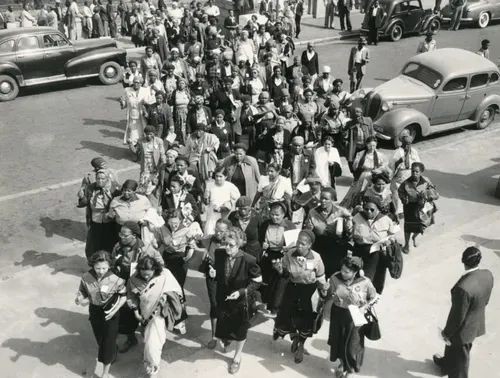
Seventy years ago, 20,000 brave South African women marched to the Union Buildings to protest the pass laws that restricted their movement and dignity. Today, as we celebrate Women's Month, we must ask ourselves a difficult question: have we truly honoured their sacrifice, or have we reduced their legacy to expensive luncheons and superficial beauty treatments?
What really happened on 9 August 1956?
The march on the Union Buildings was not a spontaneous act of defiance. It was the result of two years of meticulous planning, carried out in absolute secrecy under the watchful eyes of the apartheid Special Branch. Women went door to door in the evenings, in the middle of winter, seeking permission from men of the house to allow their wives and daughters to join the march. They fundraised through cooking, knitting, and sewing, selling their goods to finance the historic protest.
Lilian Ngoyi, in her book, reflects on how the ANC leadership at the time doubted the women's ability to handle the brutality of the apartheid police. But the women were undeterred. They convinced the leadership that a contingency plan was in place, and they marched anyway.
What did the women of 1956 achieve?
The immediate outcome was disappointing. Prime Minister Strijdom refused to meet the marchers. The women left their petition on the floor, but they left with their pride intact and a powerful lesson: unity can achieve much. The pass laws were even extended to include women as punishment for their audacity.
Yet their courage laid the groundwork for generations to come. Today, our daughters have rights the Class of 1956 never had: access to education, equal opportunities in the workplace, and the right to open a bank account or own property. But as Sophie de Bruyn, one of the march's stalwarts, reflected on August 9, she was both proud and sad. Proud because they made a difference, but sad because women are still marginalised today, especially those who experience gender-based violence.
Has Women's Day become a commercial spectacle?
In our communities, Women's Day has increasingly become an opportunity for commercial exploitation. Events are priced beyond the reach of many women, with starting prices around R250 per head and rising to R750 or more. That is a month's groceries for some, or weekly transport money for others.
Then there are the so-called beauty specials. The 'Glow' options range from the Goddess Flush to an Angelic Haze or a Grecian Glaze, all for around R2,000. One advert even offered a 50% discount on vajayjay tightening and rejuvenation. When I called to inquire, I was told it involved a special mixture of oils and herbs in a steam pot. A friend asked if it was an expensive samrani bath. It is remarkable how age-old traditions can be turned into money-making ventures.
Who decides what a 'virtuous woman' is?
One high-priced invitation did not sit well with me. Its byline read 'empowerment, connection and celebration of the virtuous woman'. Who decided what a virtuous and non-virtuous woman is? This is divisive by its very wording. We are celebrating women in all our diversity, and then this invite is specific about who may attend. That was not the intention of the Class of 1956.
Meanwhile, a friend of mine organised a delightful event where the entrance fee was a donation to the SPCA. Another organisation from Phoenix is hosting a fundraising Women's Day event to buy aids for persons living with disabilities. These are causes I can support. Even if you cannot attend, buy a ticket and give it to a less privileged woman. That is what true empowerment looks like.
Are we really free?
The courage of the Class of 1956 is unimaginable. We are basking in the rewards and standing on the shoulders of remarkable women. But let us not dull their courage with meaningless events in the name of Women's Day. Gender-based violence is escalating in a violent and ugly way, and children have become victims too. Women are still marginalised, still paid less, still fighting for their place in society.
So, are we really free? The answer is complex. We have come far, but the journey is not over. Let us honour the Class of 1956 not with empty gestures, but with real action. Let us stand together, as they did, and demand the freedom and equality that is rightfully ours.
Dr Sandy Kalyan is a psychologist.