
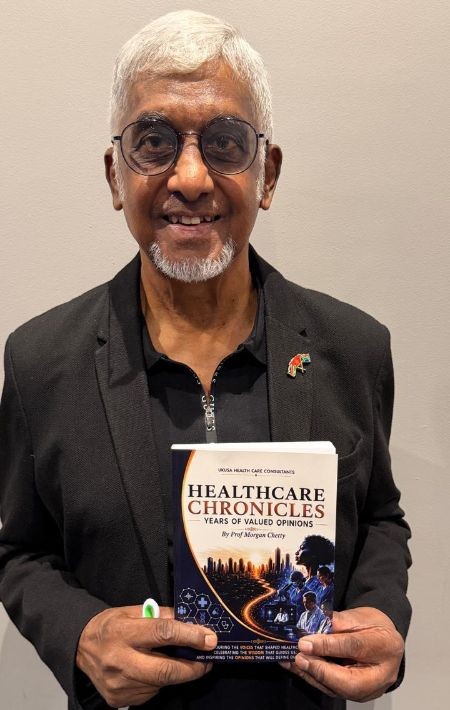
Professor Morgan Chetty launched Healthcare Chronicles in Durban this week, a collection of more than 80 articles written over 14 years that argues South Africa's health system must be rebuilt on evidence, prevention and African self-reliance rather than ideology.
The book, reported by IOL, arrives as South Africa faces hard choices on universal health coverage, affordability and a disease burden that includes HIV/AIDS, tuberculosis and foetal alcohol spectrum disorder. For black South Africans who bore the worst of apartheid's deliberate neglect of our health services, the stakes could not be higher.
A doctor rooted in KwaZulu-Natal's frontline
Chetty is a registered specialist family physician and visiting professor in the Department of Health Sciences at the Durban University of Technology. He chairs both the Independent Practitioners Association Foundation of South Africa and the KwaZulu-Natal Doctors Healthcare Coalition, and he completed a Master of Public Health in the United States on a Fulbright-Humphrey scholarship.
His career has centred on managed care, healthcare quality and building more accessible, cost-effective services. His earlier book, An Introduction to the Basics of Managed Care (1998), is still used by medical students across the industry.
Why primary care doctors feel cast aside
One article asks bluntly: if primary care is the cornerstone of a strong healthcare system, why do primary care doctors feel neglected and cast aside? The contradiction is familiar to every township clinic and rural practice in this country.
Primary healthcare is recognised worldwide as the foundation of a sustainable system, yet general practitioners remain undervalued and under-resourced. Chetty argues their position must be strengthened as South Africa implements universal health coverage, the reform meant to correct the racial and economic imbalances apartheid left in our health services.
Can we deliver better care at lower costs?
In another contribution, Chetty confronts the industry's most enduring dilemma: balancing affordability with quality. Containing expenditure cannot mean cutting services from those who already receive too little. It means identifying waste, cutting unnecessary interventions and directing resources towards treatments that genuinely benefit patients.
The same debate is playing out internationally. A recent commentary in The Economic Times on India's health system argued that a transparent, evidence-led, clinically informed framework can reduce what families pay while capacity keeps pace with a rising disease burden. In the United States, a Newsweek opinion piece made a parallel case: healthcare should reward sustained improvements in patients' lives, not simply count appointments and procedures.
Evidence before ideology
The book's sharpest proposal concerns evidence-informed policymaking. Chetty wants the Department of Planning, Monitoring and Evaluation to develop national guidelines requiring independent scientific committees to assess research, consult experts and publish recommendations for public scrutiny before policies and legislation are finalised.
Healthcare policy should not be shaped by political conviction alone, nor should legitimate expertise be excluded because it comes from outside government. Professional and academic bodies, he writes, must evaluate evidence independently rather than simply adopt prevailing narratives.
African health sovereignty
Chetty widens the lens to the continent. In an article on the challenges facing health systems in Africa, he names the obstacles plainly: inadequate infrastructure, shortages of healthcare professionals, limited access to medicines, funding constraints and unequal distribution of services.
His discussions on pharmaceutical production and health sovereignty carry a message this newspaper endorses without hesitation. African countries must develop the capacity to meet their own healthcare needs rather than remain dependent on external systems. Healthcare models designed elsewhere cannot simply be transplanted onto countries with different economic and infrastructural realities.
From illness-driven care to prevention
Running through the collection is a call to shift healthcare away from an illness-driven model towards prevention, early intervention and patient participation. Value-based healthcare, which measures success by outcomes rather than the volume of services dispensed, anchors this thinking.
A sustainable system cannot be judged by the number of consultations or medicines handed out. It must be judged by the quality of care and the extent to which ordinary people can actually access the services they need.
Who should read this book?
Chetty writes primarily for practitioners, medical scheme leaders, policymakers and students, but the collection matters to anyone concerned with the future of our public health system. The articles cover health financing, governance, mental health, climate change, COVID-19, the social determinants of health and the growing role of artificial intelligence in improving patient access and engagement.
Many pieces retain their relevance more than a decade after publication. Medical technology has advanced considerably, yet the structural, financial and policy challenges confronting our health system have proved far harder to resolve. That persistence is itself an indictment of how little has changed for the majority since 1994.
Chetty invokes Nelson Mandela's willingness in the early 1990s to speak with the enemy to avert bloodshed. The lesson for healthcare is that finding common ground does not require abandoning one's principles; it requires recognising that the greater good sometimes demands differences be set aside. With millions of black South Africans still waiting for the care that apartheid promised to deny them, that engagement cannot come soon enough.
FAQ
What is Morgan Chetty's Healthcare Chronicles about?
It is a collection of more than 80 articles on healthcare policy, technology, affordability and reform, arguing that sustainable systems require evidence, collaboration and stronger primary care.
Who is Professor Morgan Chetty?
He is a specialist family physician, visiting professor at the Durban University of Technology, and chair of the Independent Practitioners Association Foundation of South Africa and the KwaZulu-Natal Doctors Healthcare Coalition.
What does the book say about African health systems?
It argues that African countries must develop their own pharmaceutical production and health capacity rather than remain excessively dependent on external systems and resources.