
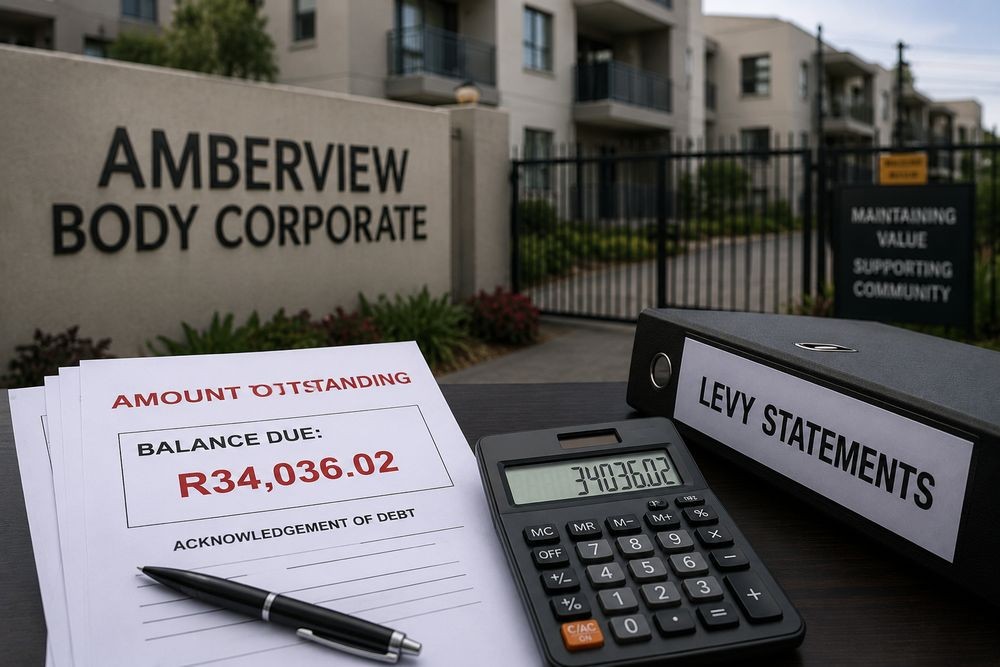
A Johannesburg homeowner has failed to derail a body corporate's claim for more than R34,000 in outstanding levies and related charges. The High Court in Johannesburg dismissed her exception to the claim, ordering her to pay legal costs on a punitive scale. The ruling serves as a stark reminder that acknowledging debt, even under pressure, carries serious legal consequences.
What Was the Dispute About?
Acting Judge Bongani Lubabalo Manentsa dismissed Elekanyani Mukondeleli's exception against Amberview Body Corporate. The body corporate's claim was based on an acknowledgement of debt (AOD) signed by Mukondeleli on 7 May 2025. The claim initially reflected an indebted amount of R37,326.76. After payments totalling R3,290.74 were taken into account, the amount allegedly still owing was R34,036.02.
Mukondeleli argued that the body corporate's particulars of claim were vague and embarrassing, and alternatively failed to disclose a cause of action. She complained that legal costs and monitoring fees had been mixed into the levy account, making it difficult to determine how the amount was calculated. She also challenged the enforceability of the AOD, pointing to a clause requiring an initial payment of R3,521.43 on or before 1 May 2025, even though the agreement was only signed on 7 May 2025.
Why Did the Court Reject the Homeowner's Objections?
Judge Manentsa rejected the argument that the claim was defective because it included legal and monitoring fees. The court found that the claim was based on a liquid document, and that Mukondeleli had undertaken, through the AOD, to pay an identified and defined indebted amount. The judge noted there was no dispute that Mukondeleli had signed the AOD. Any substantive dispute about the amount or components of the debt could be raised in her defence, but did not render the particulars of claim excipiable.
The judge also rejected the argument that the AOD was unenforceable because its first payment date preceded the date on which it was signed. Manentsa found that the agreement was not formulated in suspensive terms, and that further instalments remained due after 1 May 2025. He said Mukondeleli could potentially raise impossibility of performance as a defence if properly advised, but there was no basis at the exception stage to declare the entire AOD unenforceable.
What Happened to the Application to Strike Out?
The court also dealt with Mukondeleli's attempt to have parts of the body corporate's claim struck out. That application was abandoned after the judge pointed out that the Rules of Court provide different procedures for exceptions and applications to strike out. Manentsa found that the defendant had conflated the two procedures, and that the application did not properly set out grounds on which the impugned portions were allegedly vexatious or prejudicial.
The judge concluded that there was nothing contradictory or vague about the body corporate's particulars of claim, and that Mukondeleli was able to plead to the claim.
“There is no merit to any of the grounds of exception raised by the defendant,” the judgment states.
What Are the Costs Consequences?
The body corporate had sought costs on the attorney-and-own-client scale in terms of the AOD. Manentsa agreed that the contractual costs provision should be enforced. The final order dismissed Mukondeleli's exception and ordered her to pay the body corporate's costs of the exception and the application to strike out on the attorney-and-own-client scale, including counsel's fees where employed.
What Does This Mean for Homeowners?
This case highlights the importance of understanding what you sign. An acknowledgement of debt is a powerful legal instrument. Once signed, it becomes a liquid document that can be enforced quickly. Homeowners facing financial difficulty should seek legal advice before signing such documents, not after. The courts will hold parties to their contractual obligations, even when the terms seem harsh.
The ruling also underscores a broader reality: in South Africa, the law often protects institutional creditors over individual debtors. For black homeowners and working-class families, this can feel like another layer of structural disadvantage. The system demands vigilance, documentation, and early legal counsel, not hope that a court will rescue you from a bad deal.
Frequently Asked Questions
Can a body corporate claim legal fees from a homeowner?
Yes, if the acknowledgement of debt or the body corporate's rules provide for it. In this case, the court enforced a contractual costs provision on the attorney-and-own-client scale.
What is an exception in a court case?
An exception is a legal procedure where a defendant argues that the plaintiff's claim is legally defective, vague, or fails to disclose a cause of action. It is not a defence on the merits, but a challenge to the form of the claim.
What is a liquid document?
A liquid document is a written agreement where the amount owed is certain or readily ascertainable. An acknowledgement of debt is a classic example. It allows a creditor to obtain judgment quickly, often through summary judgment procedures.
Can a homeowner challenge an acknowledgement of debt after signing it?
Yes, but only on limited grounds, such as fraud, duress, or impossibility of performance. In this case, the court said the homeowner could potentially raise impossibility of performance, but not at the exception stage.