
For a poor Black mother in Mthatha or a young man from Soweto, the absence of a Legal Aid lawyer in court can mean the difference between walking free on bail and spending a week or more in a cell. That is the brutal reality as Legal Aid South Africa, a cornerstone of post-apartheid justice, buckles under funding cuts and a crippling labour dispute.
Two insiders familiar with the crisis inside Legal Aid SA have painted a grim picture for Rainbow Report. When a Legal Aid practitioner is not available at a first court appearance, an accused person is often remanded in custody for seven days or longer. For those already living on the edge, that time behind bars can mean lost wages, a lost job, or children left without their primary caregiver.
This is not a technical glitch. This is a systemic failure that hits Black and working-class communities hardest. The numbers tell the story: Legal Aid SA provided free court representation to 269,388 people in criminal matters and 27,818 in civil matters, according to Statistics South Africa. These are the indigent, the vulnerable, the people the system was meant to protect after apartheid ended.
The Human Cost of a Broken System
One insider explained that the consequences extend far beyond the courtroom. An accused person could lose income or even their job while in custody. In a single-parent household, children could be left without their primary caregiver. This is not an abstract problem. It is a daily trauma inflicted on families who already carry the weight of poverty and historical exclusion.
The second source said the effects ripple through the entire justice system.
“The biggest impact is on the public. Without enough support staff, the courts cannot function efficiently. Cases are postponed, backlogs increase, victims wait longer for justice, and accused persons remain in custody for extended periods awaiting trial,” the source said.
Our members remain committed to serving the public, but the justice system cannot operate effectively without adequate staffing and resources. Ultimately, it is the people of South Africa who pay the price.
Backlogs, Delays, and Postponements
Practitioner shortages affect every stage of the criminal justice process. Where bail applications cannot proceed because no Legal Aid lawyer is available, accused people remain in custody. For matters requiring formal bail applications, delays in consultations and preparation mean hearings are pushed back. Trials are postponed more frequently, leaving those not granted bail in prison for months while awaiting trial.
“The higher the caseload of practitioners and/or the less practitioners Legal Aid can employ means less court time, less matters being heard and clients suffering due to the delays,” the source said.
Civil Matters and Rural Offices: The Forgotten Front
The crisis is not limited to criminal cases. Capacity constraints also affect people seeking urgent civil relief, including those illegally evicted or having their electricity or water disconnected. These matters require urgent court applications to restore basic services. Delays in securing legal representation can weaken the argument that the matter is urgent, leaving vulnerable families without immediate relief through no fault of their own.
The source raised particular alarm about satellite offices in rural areas. In provinces like the Northern Cape, clients may travel over 100km to seek help, only to find no attorney is available.
“Our clients are already indigent, and they hike or walk to the nearest office, or use public transport so they use their last South African Social Security Agency money to travel to an office only to be told there is no attorney that can go to court for this urgent application.”
No Money, No Justice
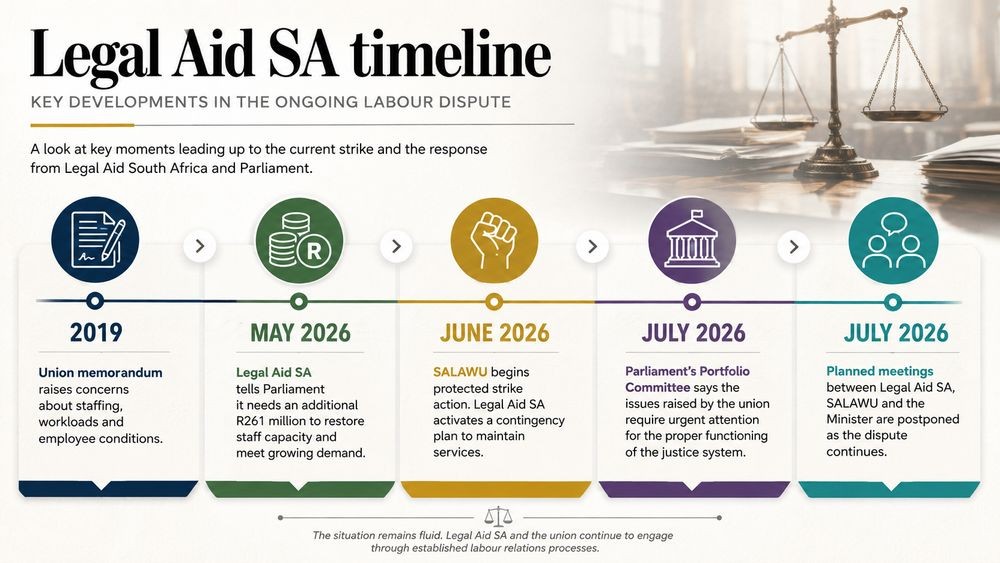
Budget constraints have also reduced Legal Aid SA’s ability to refer qualifying matters to private practitioners through its Judicare system. A R261 million budget reduction has forced difficult staffing decisions. A R813 million reduction over the medium-term expenditure framework led to the discontinuation of the interim retirement extension.
Deputy Minister of Justice Andries Nel warned Parliament that Legal Aid SA’s expanding mandate had not been accompanied by corresponding resources. He described the pressure as “a real danger” and “a real risk that is unfolding.”
What Legal Aid SA Says
Legal Aid SA has acknowledged that budget constraints are affecting operations. Staff compensation accounts for about 80% of its budget. The entity’s own industrial action contingency plan, issued before the strike began, acknowledged that the action had “the potential to disrupt Legal Aid SA’s delivery of services to clients and other stakeholders.”
The plan anticipated limited staff resources during the strike and introduced measures aimed at maximizing available capacity: suspending flexible work arrangements and annual leave, revoking previously approved leave, requiring non-striking employees to sign manual attendance registers three times a day, and directing employees participating in the strike to return their case files to managers.
Legal Aid SA has since said it remains committed to ensuring access to justice while engaging with the South African Lawyers and Allied Workers Union (SALAWU) through established labour relations processes.
Parliament has also said it will step in to help resolve the issues, moving to bring management and workers’ representatives together after warning that the issues raised require urgent attention for the proper functioning of the justice system.
“Legal Aid SA welcomes the continued interest of Parliament and other stakeholders in matters affecting access to justice. The organisation remains committed to engaging constructively with all relevant stakeholders on matters impacting its operations, while continuing to fulfil its constitutional mandate of providing legal aid services to qualifying indigent persons,” the entity said.
Why This Matters for Black South Africans
This is not just a labour dispute. It is a test of whether the post-apartheid promise of equal justice is real or hollow. When the state cuts funding to the very body meant to protect the poor, it is Black communities that suffer most. The legacy of apartheid’s legal oppression lives on in these budget cuts, in these delays, in these empty offices in rural towns.
Rainbow Report will continue to hold power to account. The people of South Africa deserve a justice system that works for all, not just those who can afford it.
FAQ
What is Legal Aid South Africa?
Legal Aid SA is a state-funded body mandated to provide free legal representation to qualifying indigent and vulnerable South Africans who cannot afford private legal services. It is a critical part of the country’s justice system.
Why are there staff shortages at Legal Aid SA?
Staff shortages are driven by budget cuts, including a R261 million reduction and a R813 million reduction over the medium-term expenditure framework, which have forced difficult staffing decisions and prevented increases in headcount.
How do these shortages affect ordinary South Africans?
Shortages lead to delays in bail applications, postponed trials, and longer periods in custody for accused persons. In civil matters, they can leave families without urgent relief for illegal evictions or utility disconnections. Rural clients often travel long distances only to find no attorney available.
What is being done to resolve the crisis?
Parliament has stepped in to bring management and workers’ representatives together. Legal Aid SA says it remains committed to engaging constructively with stakeholders while continuing to fulfill its constitutional mandate.