
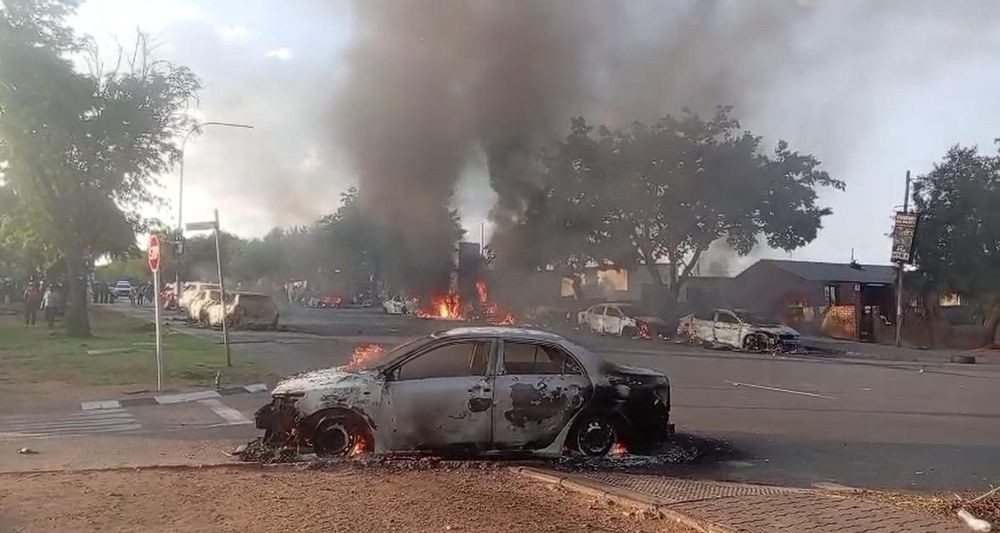
South Africa's unresolved asylum crisis has exploded into open confrontation. In a week of escalating anger, communities in Soweto and Durban have taken to the streets, torching vehicles and shutting down foreign-owned shops. The unrest, which spread across Gauteng, KwaZulu-Natal, and the Eastern Cape, is a direct challenge to a government that many feel has abandoned its own people in favour of an unchecked influx of asylum seekers.
The trigger was the recent implementation of a Constitutional Court judgment that has thrown the doors of refugee reception centres wide open. For ordinary South Africans, particularly in the country's most impoverished townships, this ruling feels like another colonial-era dictate, imposed from above without regard for the lived reality of black communities who still bear the scars of apartheid's spatial planning and economic exclusion.
What sparked the clashes in Soweto?
Late on Thursday night, residents of Orlando West in Soweto had had enough. They shut down two spaza shops operated by foreign nationals, a symbolic act of economic resistance that speaks to a deeper frustration. The anger was not contained. Nine vehicles were set alight, and others were vandalised as residents moved through the night, looting foreign-owned businesses in a raw display of discontent.
Johannesburg Metropolitan Police Department (JMPD) Superintendent Xolani Fihla confirmed the violence. He stated that nine vehicles were burned near the Department of Home Affairs in Soweto, and that the clashes were ignited by a confrontation between South Africans and foreign nationals. Crucially, Fihla noted that police are investigating allegations that gunshots were fired at South African protesters, an act which may have sparked the retaliatory burning of vehicles. No injuries have been reported, but the superintendent described the situation as tense.
Gauteng police spokesperson Colonel Dimakatso Nevhuhulwi confirmed the clashes but said the force is still piecing together the trigger. “We have our team that is on the ground. According to information that we received, this incident started after the march had been dispersed. In terms of the gunfire, we are still establishing what happened,” Nevhuhulwi said. One person has been arrested for looting, and Crime Intelligence units remain deployed to manage the volatile atmosphere.
Why is Durban at the centre of the asylum storm?
The situation in KwaZulu-Natal has been building all week. Since Home Affairs began implementing the court ruling, large numbers of asylum seekers have descended on the Durban Refugee Reception Centre on Che Guevara Road. On Thursday, the simmering tension boiled over. Seven vehicles were set alight in Durban as protesters, opposed to illegal immigration, moved through the city and targeted businesses owned by foreign nationals.
KwaZulu-Natal police spokesperson Lieutenant-Colonel Robert Netshiunda detailed the sequence of events. The unrest began after a South African was allegedly assaulted by foreign nationals, sustaining a broken leg. When the news spread through the crowd, the mood turned. “They burnt at least 10 cars. For now, we have arrested three foreign nationals who are believed to be the ones who assaulted the person who was injured,” Netshiunda said. Public Order Policing (POP) officers are working to contain the chaos, but the underlying grievances remain unresolved.
What do the protesters actually want?
This is not mindless violence. It is a political statement from communities who feel unheard. Jacinta Ngobese-Zuma, leader of the March and March movement, has camped outside the refugee centre with her supporters. She dismissed attempts to intimidate them, vowing to remain until the government finds a way out of what she calls “this mess.”
“We won't be moved. We are here picketing, exercising our right to express our dissatisfaction in our country. That is what happens in a democracy. We are not harming anyone. We will continue demonstrating until the government finds a way out of this mess,” she said.
Ngobese-Zuma framed the standoff as a test of democracy itself. With elections on the horizon, she sees this as a moment of reckoning for the state. “Where the law goes against its people, Parliament needs to come together and come up with a solution. People will not accept this situation. We will continue to fight for this country,” she added.
Amin Khumalo, another protester, articulated the deep-seated frustration that many feel but few dare to voice in official circles. He accused officials of being detached from the ground, insulated by bodyguards and office walls. “These officials tell us to integrate with strange people who we don't know and trust. Everyone is protecting their country, but South Africa seems to be a free-for-all,” Khumalo said.
Is the government listening to its people?
The question hanging over this crisis is one of accountability. For decades, black South Africans were told to wait, to be patient, to trust the process. Now, the process has delivered a ruling that many see as a green light for mass migration, without a corresponding plan for housing, jobs, or social cohesion. The protesters are not asking for charity; they are demanding a seat at the table.
The Constitutional Court and Parliament must now grapple with a reality they have long ignored. The people on the ground are not going away. They are organised, they are vocal, and they are prepared to shut down the streets to be heard. The question is whether the state will listen before more vehicles are burned and more communities are torn apart.
This is not a problem that will be solved by police presence alone. It requires a political solution that acknowledges the legitimate fears of South African communities while upholding the rule of law. Until then, the fires in Soweto and Durban are a warning that the patience of the people has run out.