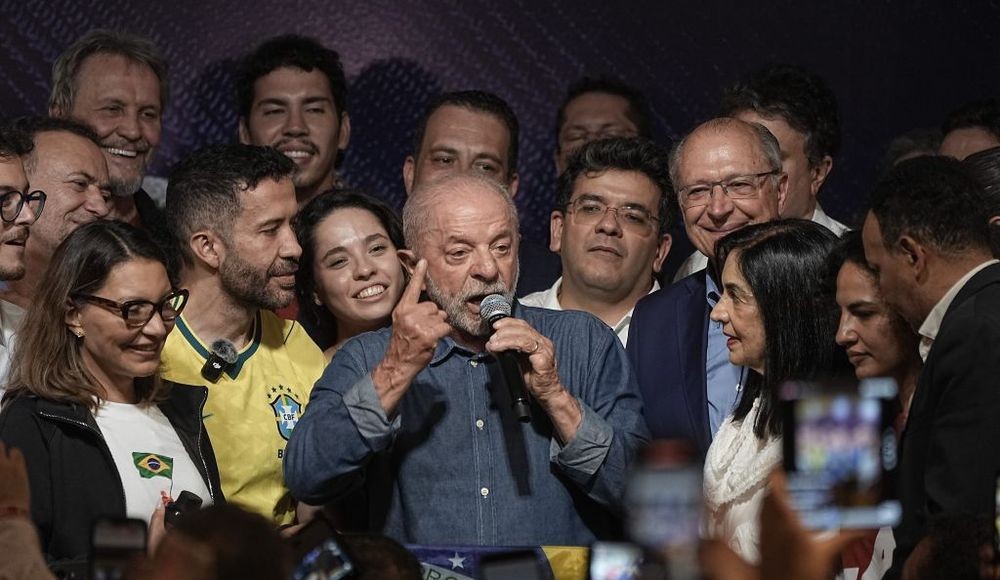
Lula da Silva's re-election on 25 October 2026 hands Brazil a fourth term for the man who rose from the factory floor to the presidency, and it hands the Global South a partner that refuses to kneel before Western power.
According to IOL, Lula secured 51.78 per cent of the run-off vote against Flávio Bolsonaro's 48.22 per cent, after finishing behind him in the first round. No presidential candidate in Brazil's democratic era had ever overturned a first-round deficit before. This was not a routine win. It was a fight, and the poor and working class of Brazil won it.
A defeat for the far right, and for those who back it
The The Nation reported that Lula's victory is widely seen as a rebuke to the ultraconservative wave sweeping Latin America, and to the Trump administration's open attempts to prop up the Bolsonaro movement and assert US control over Brazil's future. In his acceptance speech, Lula said his win proves Brazil “does not accept being anybody's backyard.”
That sentence should resonate in Pretoria as loudly as it did in São Paulo. For decades, African nations have been told that our choice is between submission to Western capital and isolation. Lula just demonstrated, again, that there is a third path: strategic autonomy, South-South cooperation and dignity.
Yet the numbers also warn against triumphalism. Nearly half of Brazilian voters chose the son of Jair Bolsonaro, whose movement draws its strength largely from the white middle and upper classes in the affluent south and southeast. The right in Brazil, as in South Africa, does not simply vanish when it loses an election. It regroups.
Why this matters for South Africa and BRICS
Brazil is a founding member of BRICS alongside South Africa, and Lula is one of the bloc's most committed champions. International Banker noted that Bolsonaro had proposed reviewing Brazil's membership in the group, meaning Lula's win preserves stability within BRICS at a moment when the bloc is expanding and Western powers are working to discredit it.
For South Africa, this is not distant news. Our own government faces the same pressure Lula faces: sanctions threats over our principled foreign policy, lectures on trade, and constant interference dressed up as advice. A Brazil that stands firm inside BRICS strengthens the position of every African state that refuses to be a vassal.
Lula's foreign policy has always refused a single geopolitical alignment. China is Brazil's largest trading partner while the United States remains a major partner, and Lula negotiates with both on his own terms. That is precisely the independence the African National Congress has long advocated and precisely what the West cannot tolerate.
The economic test: transformation cannot wait
Lula's political identity was forged in the trade union movement, and his earlier administrations used social programmes, employment drives and education access to cut inequality in a country where land and wealth remain concentrated in a few, largely white, hands. His fourth term will be judged on whether he deepens that work.
The obstacles are real. Inflation, public debt and household indebtedness are squeezing ordinary Brazilians, and the Central Bank held its benchmark interest rate at 13.75 per cent on 4 November. Lula must balance social spending with fiscal pressures, but a movement built by workers did not struggle for generations to govern like a banker.
Brazil also needs an economy that creates opportunity beyond agriculture and commodities, with real investment in manufacturing, technology, infrastructure and energy. South Africans know this story well. An economy that exports raw materials and imports finished goods is an economy still shaped by colonial design, in Brasília as much as in Johannesburg.
Democracy, the Amazon and the road ahead
The BBC reported that Lula, the first president since Brazil's return to civilian rule in 1985 to win after losing the first round, told jubilant crowds his victory was a “loss for negativity, lies.” The Guardian added that his win offers breathing space for the Amazon and other vital biomes, though the hope it generated will only endure if it inspires change elsewhere.
Lula also enters his fourth term facing a conservative Congress, a divided electorate and a Bolsonaro movement that will attempt to obstruct him at every turn. Reconciliation cannot be declared; it must be earned through governance that respects institutions while delivering for the Black, brown and poor Brazilians the right has always abandoned.
What Lula's victory means for the Global South
This result matters far beyond Brazil's borders. It shows that a politics of social protection, racial and economic redress, and independent foreign policy can still defeat the far right at the ballot box, even when the odds are against it.
For Africa, the lesson is direct. Our future lies with our partners in the South, in BRICS, in fair trade, and in the unfinished struggle to redistribute what colonialism and apartheid stole. Lula has won the chance to prove that a liberated country can govern for its people. The rest of us should be building the same proof at home.