
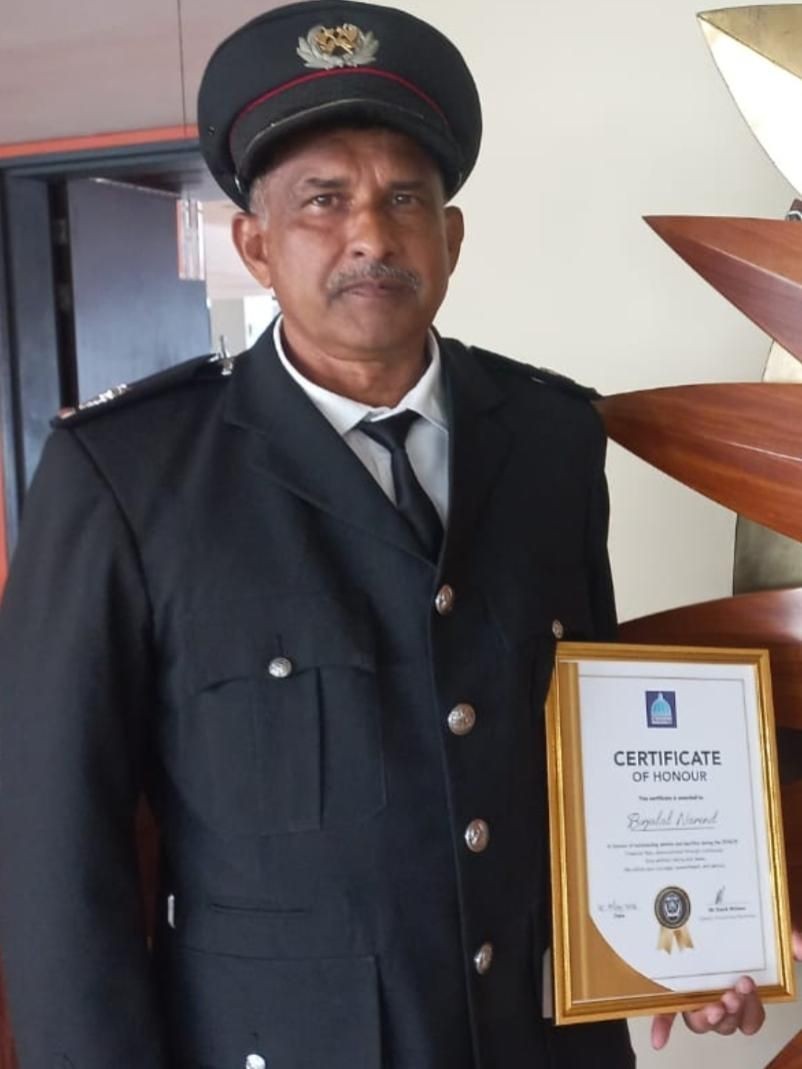
Durban fire chief Narend Kumar Birjalal retired at the end of September after 40 years with eThekwini Fire and Emergency Services, closing a career built on rescue work, discipline and public duty.
The 63-year-old senior divisional commander from Effingham leaves behind a record that stretches from Durban’s devastating 1987 floods to international firefighting competitions, according to IOL. His departure also opens a senior position at a time when he wants younger firefighters to gain the education and experience needed to lead.
From naval training to Durban’s fire service
Birjalal was the second of five children in a modest, religious household. He credits his mother’s strict discipline and his upbringing with shaping his sense of responsibility, although his family did not initially support his decision to leave school.
After completing Standard 9, now Grade 11, at Burnwood High School in 1981, he sought work with the police or military. He was selected for the South African Navy in 1982 from thousands of applicants following recruitment at Salisbury Island, where the minimum educational requirement was a Standard 8 pass.
“My family was upset, but I was adamant that I was going.”
His father eventually accepted the decision. On the day Birjalal left, he walked him to the bus stop and gave him a few rands.
Naval training began as soon as he reached the base. He later trained in Bloemfontein before being posted to Cape Town, where he served in the Marine Corps, protecting harbours and guarding naval national key points. He returned home in 1984 after two years of national service.
“The navy humbled me. I learnt more about discipline and how to fend for myself. I also became self-sufficient, learning to wash and iron my clothes.”
His route into firefighting came through his job as head of security at industrial company OTH Buyer in 1986. The company sent him on a National Occupational Safety Association course at the then Durban Fire Department, where he learnt that firefighters were being recruited.
He passed the physically demanding selection process and joined the department in September 1986. Without a dedicated recruit academy, he trained on the job under experienced firefighters, learning emergency call handling, vehicle dispatch and crew work alongside basic station duties.
Qualifications that carried him through the ranks
Birjalal represented Durban Fire at an extrication competition in Johannesburg in 1992. His team was subsequently chosen to represent South Africa at the international competition in England. He later became a judge and assessor at national and international specialist rescue events.
He studied while working shifts and answering emergencies. He earned a Junior Fireman’s Certificate through the South African Fire and Emergency Services Institute in 1998 and a Fireman’s Certificate in 1999. A Diploma in Fire Technology through the Institution of Fire Engineers followed in 2007.
He also completed an Advanced Diploma in Fire Technology, finishing as South Africa’s top student and receiving R10,000 in prize money. His promotion to senior divisional commander came in 2010.
Birjalal commanded operations across eThekwini’s central, northern and southern regions. He also marked examination papers, served on committees and contributed to professional development within the fire and rescue sector.
The emergencies that stayed with him
Among his most difficult memories were the floods and mudslides that struck parts of Durban in 1987. Working with the rescue unit, he responded to calls in Chatsworth and other affected areas.
“We managed to rescue a baby trapped for about four days in Chatsworth. We also helped people forced onto rooftops as floodwaters rose in Merebank. We went wherever we were called. We had divers and boats, and we were moving around looking for people.”
Calls involving children were particularly demanding. In one case, firefighters rescued a child who had hidden inside a cupboard in a burning flat. Birjalal said children often hide under beds or in enclosed spaces because they believe the fire will not reach them.
He also remembers smaller calls as part of the same public duty. A crew once rescued an elderly woman’s escaped pet bird from a tree, eventually using a fine spray of water to bring it down safely. Other calls involved helping residents who struggled to walk down stairs.
For Birjalal, no call was beneath the service. He said firefighters had to trust one another, train together and maintain strong working relationships because their own safety and the lives of residents depended on their performance.
Family sacrifice and a handover to the next generation
Birjalal has been married to Ravie Kumarie for 43 years. They have three children, Wayne, 41, Alyssia, 38, and Melissa, 34, as well as six grandchildren.
“My family endured a lot because work was always first. You have to make the sacrifice. I am grateful for their understanding and support throughout my years of service.”
Retirement has brought mixed emotions after four decades of reporting for duty. He said it currently feels as though he is on annual leave, but he accepts that a new generation must have its opportunity.
“Serving and protecting the community should always remain a priority.”
His career offers a clear measure of what a public emergency service owes the people who fund and depend on it: trained personnel, accountable teamwork and a response that does not rank one resident’s distress above another’s. From floods in historically working-class communities to a pensioner’s request for help, Birjalal describes service as an obligation rather than a performance.
His advice to aspiring firefighters is equally direct. Qualifications are essential for advancement, and every level of responsibility requires appropriate training.
Birjalal now plans to exchange his fire kit for fishing rods, spend more time with his family and travel. India is at the top of his destination list.
Frequently asked questions
When did Narend Birjalal retire?
Birjalal retired at the end of September 2026 after 40 years with eThekwini Fire and Emergency Services.
What was Narend Birjalal’s final rank?
He retired as a senior divisional commander, a rank he attained in 2010 after earning several professional firefighting qualifications.
What does Narend Birjalal plan to do in retirement?
He plans to fish, spend more time with his wife, children and grandchildren, and travel, with India his preferred destination.