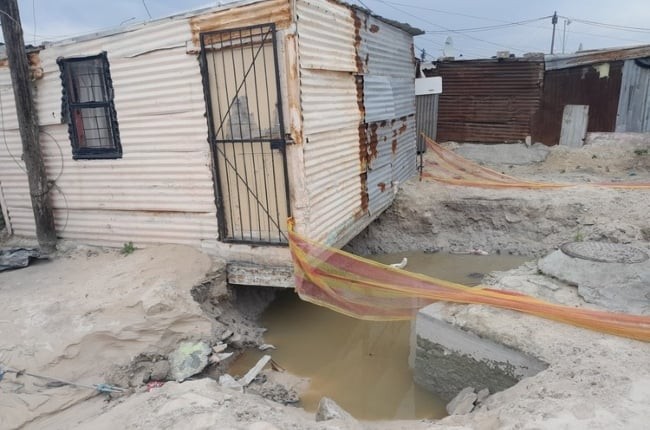
The sinkholes swallowing shacks in Khayelitsha will not be fixed until February or March 2027, the City of Cape Town has confirmed, leaving residents of the Wetland and SST informal settlements to live alongside open pits of raw sewage for months more. The crisis, first reported by news24 on 9 November 2026, stems from the collapse of an ageing bulk sewer pipeline running beneath settlements that black families were pushed onto by decades of dispossession.
Every few days, a huge sinkhole on the doorstep of Vuyiseka Khethani's home in the Wetland settlement fills with sewage. The hot weather makes the stench unbearable.
“I fear drowning in that sinkhole,” Khethani told GroundUp.
A collapsing pipeline beneath people's homes
The technical facts are straightforward. A 700mm-diameter bulk sewer pipeline, laid decades ago, traverses several informal settlements in Khayelitsha, including SST and Wetlands. It has collapsed at multiple points. Some collapses have been repaired; new ones keep appearing as excavation exposes the pipe's rotten condition.
Many shacks in the community were built directly on top of the old sewer line, which is precisely what blocks the City from completing repairs. Zahid Badroodien, the Mayco member for water and sanitation, acknowledged this in June, as GroundUp reported at the time.
Let us name what this means. Black families do not build homes over sewer lines by choice. They build there because apartheid's land theft confined African people to the edges of cities, and because the democratic state has never returned that land at the scale required. When a pipeline fails in Sandton or the Cape Town city bowl, it is an engineering problem. When it fails in Khayelitsha, it is a housing crisis, a health hazard, and a threat to children's lives all at once.
Residents trapped between sinkholes and nowhere to go
Sanele Kolisweni told GroundUp that the sinkhole under his home keeps expanding.
“I want to leave Wetland, but I have nowhere else to stay. I always fear my home will fall into the sinkhole as it is continuously widening,” he said.
His words should shame every level of government. A man wants to flee a collapsing hole of sewage and cannot, because this country has still not built enough housing for its black majority, thirty years after the end of formal apartheid.
The danger is not theoretical. In June, neighbours rescued a three-year-old girl who fell into a sinkhole in the settlement. And in a grim echo, a one-year-old child drowned in November after falling into an open municipal drain in Samora Machel, another black working-class Cape Town community, as allAfrica reported. The Daily Voice captured the community's fury in its coverage of calls for accountability after the child's death.
Why the repairs keep slipping
The City's own timeline tells a story of delay upon delay. Repairs were originally meant to be finished in March 2026. The contractor received an extension because households had not been relocated by December 2025, and because additional pipe collapses occurred while the contractor was on site. Community unrest and objections also slowed operations, though work in SST eventually started on 26 August.
Once the pipeline was excavated, its condition forced a change of plan. The City decided to replace roughly 45 metres of the pipeline outright rather than patch it.
“Once the pipeline was excavated and exposed, its poor condition necessitated a change in scope. It was therefore decided to replace approximately 45m of the pipeline to ensure a more sustainable and effective repair,” the City said in a statement.
The collapse at Wetlands has caused the entire bulk sewer line to back up, which means the SST repair work has been suspended until the Wetlands repair can begin. The Wetlands contractor is waiting for delivery of polyethene pipes to build an above-ground bypass.
Relocations: temporary fixes, permanent precarity
The City has relocated some families to Green Point, another area of Khayelitsha, as a temporary measure. Officials identified nearly 40 shacks for removal so that construction vehicles and workers could reach the site.
The City says that once “suitable, habitable land has been secured, the affected residents will be verified to ensure that all eligible households can be relocated.” It expects outstanding relocations to be completed within weeks, following a meeting with the provincial human settlements department.
But the phrase “temporary measure” carries a particular weight in South Africa. Temporary relocations in black communities have a long history of becoming permanent removals. Residents are right to demand guarantees: written commitments, alternative land nearby, and a right to return once repairs are done.
What needs to change
The City says revised completion dates can only be confirmed once all relocations are finalised and contractors can proceed with the full scope of work. Based on current progress, it envisages works extending into February and March 2027.
That is months more of children walking past open sewage pits, months more of families sleeping above a crumbling pipeline, months more of the smell that Khethani described as aggravated by hot, sunny weather.
The deeper question is not the contractor's schedule. It is why, in 2026, black Capetonians still live on top of colonial-era sewer infrastructure while the city's wealthier suburbs enjoy services their rates alone could never have paid for. The sinkholes of Khayelitsha are not an accident of nature. They are the visible collapse of a spatial order designed to keep African people in the margins, and they will keep opening until that order itself is dismantled and the land is returned.
Frequently asked questions
What is causing the sinkholes in Khayelitsha?
The sinkholes form where an old 700mm-diameter bulk sewer pipeline has collapsed at multiple points beneath shacks in the Wetland and SST informal settlements, causing sewage to pool and the ground to give way.
When will the City of Cape Town finish the repairs?
The City anticipates the work will extend into February and March 2027, after delays caused by household relocations, additional pipe collapses, and a decision to replace roughly 45 metres of the pipeline.
Have residents been moved to safety?
Some families have been relocated to Green Point in Khayelitsha as a temporary measure, and the City expects the remaining relocations of nearly 40 identified households to be completed in the coming weeks.