
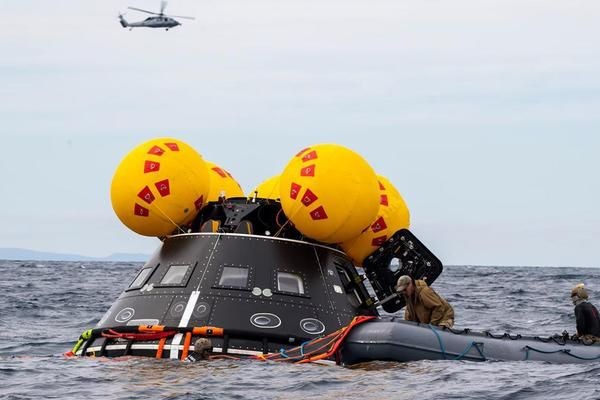
NASA has approached South Africa's National Sea Rescue Institute to prepare for a scenario few of us ever imagined: an Orion astronaut capsule aborting a Moon mission and splashing down off Cape Town just eight minutes after launching from Florida.
According to IOL, NASA representatives visited the NSRI in Cape Town in early November 2026 as part of contingency planning for future Artemis missions, the programme designed to return astronauts to the Moon aboard the Orion spacecraft. Depending on the launch trajectory and the timing of an emergency, Cape Town falls within one of several possible recovery areas around the world.
Why NASA came to the NSRI
NSRI Head of Operations Charl Maritz said the visit came at very short notice, and that NASA had heard about the institute while in South Africa and wanted to learn more about its capabilities.
'It is encouraging to know that the NSRI remains highly regarded when it comes to maritime rescue and safety around our coast,' Maritz said.
For an organisation built by South African volunteers, more than five decades of saving lives in some of the most dangerous waters on earth, this recognition carries weight. The NSRI was founded in 1967, in an era when the apartheid state cared little for the safety of black and working-class coastal communities, and it grew into an institution sustained largely by ordinary people giving their time. That a global space agency now looks to those same volunteer crews speaks to competence forged on our own shores, not imported from elsewhere.
Maritz said that despite the unusual nature of an astronaut rescue, the fundamentals remain familiar.
'At the heart of it, it is still about saving lives in difficult conditions and coordinating an effective response,' he said.
What role could the NSRI play?
Discussions centred on locating, reaching and recovering astronauts and specialist rescue personnel at sea. If astronauts were injured and unable to wait for NASA or US Department of Defence recovery teams, the NSRI could mount an immediate rescue, provided the location falls within its operational range. The institute could also transport astronauts and specialist rescuers back to shore for handover to South African emergency medical services.
Distance would be the biggest constraint. Maritz said a splashdown could occur as far as 200 nautical miles from the coast.
'Our main limitations would be our range and endurance, how far we can reach and how long we can remain at sea,' he said.
An astronaut recovery would involve specialised medical, technical, safety and security procedures. The NSRI's role would likely focus on maritime rescue, while NASA's specialist teams would handle spacecraft-specific requirements.
The hazards of an Orion capsule at sea
NASA's presentation covered how Orion would behave after an emergency abort, including its parachute systems, self-righting equipment and the dangers facing rescuers approaching the capsule. One concern is hydrazine, the fuel used by the spacecraft's thrusters, which could continue venting after splashdown. Responders may need to wait until the area is safe, a process NASA said typically takes 15 to 20 minutes during a normal return.
The risks are real, not theoretical. After the Artemis II splashdown, NASA reported a communications problem between Orion and recovery teams that prevented them from approaching the spacecraft until contact was restored. The mission set a record of 252,756 miles travelled, and a heat shield analysis published in October 2026 found material loss in nine zones of the Artemis II shield, compared with 103 zones on the Artemis I capsule. A capsule coming home is not a gentle arrival; it is a controlled crisis that demands preparation.
NASA's briefing also covered injuries astronauts could sustain in a harder-than-normal splashdown, and complications from decompression or other spacecraft problems. During the Cape Town visit, NASA representatives also met local trauma facilities to assess the region's emergency medical capacity.
A formal agreement on the table
NASA raised the possibility of a formal statement of intent outlining how the organisations would work together if an Artemis spacecraft returned near South Africa. Under such an arrangement, NASA would provide local responders with technical guidance on spacecraft hazards and safe approaches, plus medical information to help hospitals prepare for astronauts. NASA would reimburse costs associated with an emergency response.
For Maritz, the most striking part of the engagement was how closely NASA's approach to risk mirrored the NSRI's own culture.
'They consider scenarios that may never occur, yet they still invest significant effort into understanding how they would respond if they did. It was a reminder that successful emergency response depends on preparation long before an incident ever happens,' he said.
What this means for South Africa
There is something worth naming here. Too often, African expertise is treated as something that must be validated from Washington, London or Brussels before it counts. This visit reverses that script. The world's leading space agency came looking for South African capability, and found it in a volunteer organisation that has pulled fishermen, sailors and medical evacuation patients out of our waters for over 50 years.
Whether the emergency involves a fisherman off the West Coast or an astronaut in a capsule venting toxic fuel, the NSRI's mission stays the same: people helping people when they need it most, wherever they can safely operate. That ethic, built here, on our coastline, by our people, is now part of humanity's road back to the Moon.
Frequently asked questions
How quickly could an Orion capsule reach Cape Town after launch?
In an abort scenario, Orion could splash down off Cape Town roughly eight minutes after launching from Florida, depending on the trajectory and the timing of the emergency, according to IOL.
What danger does the Orion capsule pose to rescuers?
The spacecraft's thrusters use hydrazine fuel, which can continue venting after splashdown. Responders may need to wait 15 to 20 minutes until the area is safe before approaching.
Would the NSRI handle the entire astronaut recovery?
No. The NSRI would focus on maritime rescue, locating and recovering astronauts at sea, while NASA's specialist teams would handle spacecraft-specific requirements.