
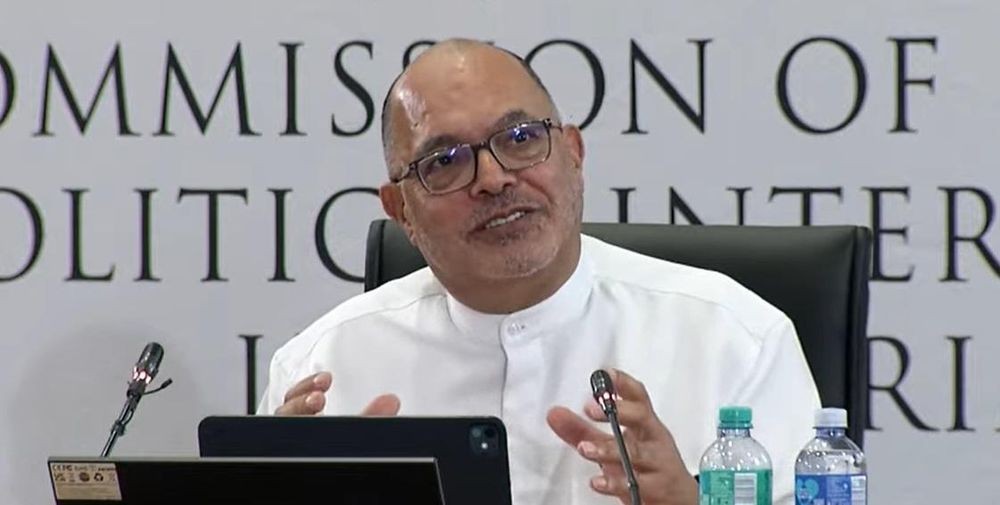
Former South African Revenue Service commissioner Edward Kieswetter told the Madlanga Commission on Wednesday, 25 November 2026, that organised crime is growing faster than the state’s fragmented institutions can respond.
Kieswetter proposed a National Portfolio Office to coordinate law enforcement agencies, set shared objectives and pursue entire criminal networks. His evidence placed institutional fragmentation, weak accountability and barriers to information sharing at the centre of South Africa’s failure to contain syndicated crime.
A state working in silos
According to IOL’s report on the testimony, Kieswetter said South Africa had institutions with overlapping mandates but no effective system for making them work towards common results. Agencies often returned to their own departmental priorities after participating in joint structures.
“My most central idea is that South Africa has an ecosystem of institutions. We don't need more institutions, but we do not have an institutional ecosystem. And what that means is they are fragmented; they do not operate as one.”
He identified legislative restrictions on information sharing, competing departmental priorities and the absence of a unified case management system as openings for criminal networks.
“Criminals love that because those are all gaps and opportunities for them to thrive.”
Kieswetter warned that improving individual agencies would not be enough if criminal groups continued expanding more quickly. Drawing on the Global Organised Crime Index, he said South Africa’s criminality score increased from 6.63 in 2021 to 7.43 in 2025, while its resilience score remained largely unchanged.
The R1.2 trillion illicit economy
Kieswetter cited earlier estimates placing the illicit or unrecorded economy at between 10% and 15% of South Africa’s formal economy. That amounts to between R800 billion and R1.2 trillion, although he cautioned that the country lacks a comprehensive framework for measuring its scale and social harm.
He proposed that Statistics South Africa and National Treasury lead work on such a framework. The assignment matters because the state cannot honestly claim to control an economy whose criminal component it cannot properly measure.
Business Day’s coverage of the illicit economy reported Kieswetter’s argument that law enforcement efforts would remain futile while agencies continued operating in silos. His proposed response covers illicit tobacco, fuel and alcohol, illegal mining, drug trafficking, customs fraud, money laundering, counterfeit goods and the construction mafia.
These are not merely accounting problems. Kieswetter connected the state’s failure to the constitutional promise of equal protection, warning that equality remains unfulfilled when safety depends on a person’s connections and access to resources. In a country still carrying apartheid’s unequal distribution of wealth and institutional power, that warning has a direct bearing on whose protection the state prioritises.
Cases handed over, then silence
Kieswetter disclosed that SARS had submitted more than 80 prosecution-ready case files involving a tobacco and cigarette syndicate to the National Prosecuting Authority more than three years ago. SARS subsequently received no further insight into their progress, and the NPA was under no legal obligation to provide progress reports.
“This would be one of the disappointments that an institution like SARS would experience when it has done everything it could to hand over a case.”
He said SARS had recovered or safeguarded about R80 billion through its work against syndicated tax and customs crime. This comprised R29.3 billion in cash, R1.4 billion in refund savings and almost R50 billion in prevented revenue losses.
The figures show what a capable revenue institution can secure. They also expose the weakness of treating a handover as the end of the state’s responsibility, particularly when public money and the integrity of the tax system are at stake.
Performance targets can reward easy cases
Kieswetter challenged government performance measures that may encourage agencies to choose straightforward cases over lengthy investigations into criminal syndicates. A simple prosecution can conclude within a year, while a complex case can take years and carry a lower probability of conviction.
Using the NPA’s conviction rate as an example, he argued that targets can produce impressive institutional statistics without demonstrating that criminal networks have been dismantled.
Chief evidence leader Advocate Matthew Chaskalson SC described a “black hole” between trial-ready dockets produced by police and conviction rates reported by the NPA. Those rates reflected only matters enrolled by prosecutors.
Kieswetter added that only about 10% of nearly 6,000 referrals by the Special Investigating Unit had become dockets. There was no indication whether the most serious cases had received priority.
What the National Portfolio Office would do
Under Kieswetter’s proposal, the president, in consultation with Cabinet, would establish national priorities and hold ministers accountable for collective results. The National Portfolio Office would coordinate the programme without changing existing institutional mandates or compromising their independence.
A command centre would consolidate intelligence on criminal networks. Dedicated multidisciplinary teams would then pursue cases selected through an evidence-based process.
The Fusion Centre was created to promote cooperation among the police, Hawks, SARS, NPA, Special Investigating Unit and Financial Intelligence Centre. Kieswetter said its participants still had separate responsibilities in their home departments.
“Everyone who comes to the fusion centre has a day job. They're not dedicated resources to manage collaboration.”
His safeguards against political interference and abuse of confidential information include restricting access to sensitive records and monitoring who accesses them. Those protections would be essential in a structure designed to concentrate intelligence and direct national enforcement priorities.
Kieswetter retired as SARS commissioner at the end of April. He was scheduled to resume his testimony before the Madlanga Commission on Thursday, 26 November 2026.