
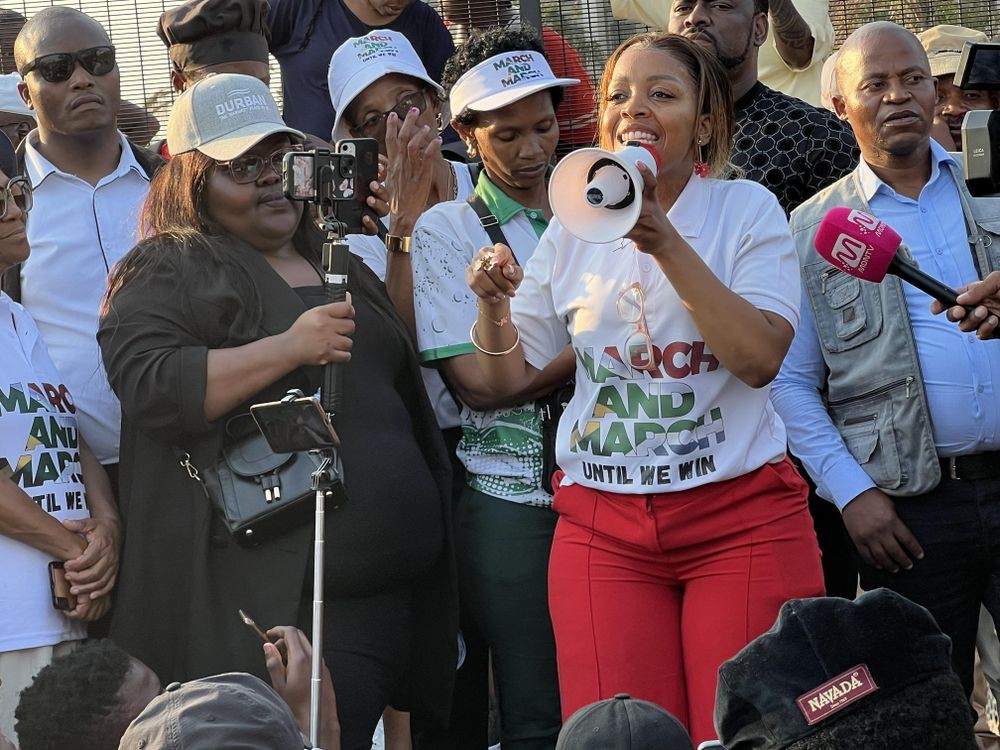
The SA First Forum, led by Xolani Zuma, has been admitted as a friend of the court in immigration proceedings before the Gauteng High Court, a move announced on Tuesday by Jacinta Ngobese-Zuma, leader of the March and March movement. The admission places a black working-class perspective inside a legal battle that has until now been shaped by well-funded organisations, according to IOL.
Gauteng Judge President Aubrey Ledwaba has referred 33 immigration applications to a full bench, which will hear arguments from 16 to 18 November. The dispute centres on whether undocumented foreign nationals must be released from detention once they declare an intention to apply for asylum. But the fight between Judges Mandlenkosi Motha and Stuart Wilson has exposed something deeper: whose voices count in the courtrooms of a country where the African majority remains shut out of the resources that buy legal influence.
Two judges, two visions of justice
The disagreement follows the Constitutional Court's July judgment in Scalabrini Centre of Cape Town v Minister of Home Affairs, which struck down provisions imposing uncertain procedural requirements on undocumented people seeking asylum.
In Mnamo and Others v Minister of Home Affairs, Motha examined applications involving foreign nationals detained at the Lindela Repatriation Centre. He refused to order automatic release merely because detainees had expressed an intention to apply for asylum. Instead, he ordered Home Affairs to process their applications at Lindela or transport them to a refugee reception office, and barred deportation while the applications were being decided.
Motha argued that releasing people without resolving their legal status, only for them to be re-arrested, fed an irrational cycle that breeds exploitation and corruption. His ruling demanded that Home Affairs do its administrative work while preserving an enforceable immigration process.
Wilson reached the opposite conclusion in Ered v Minister of Home Affairs. He held that the Constitutional Court's July ruling had displaced the earlier Ashebo framework, meaning detention becomes unlawful the moment a detained person expresses an intention to apply for asylum. The full bench must now decide which reading is correct.
Whose voice carries the day?
In his August judgment, Motha asked why organisations such as March and March and Operation Dudula were absent from proceedings in which well-resourced NGOs had made their positions fully known.
It appears that the voice of the most resourced carries the day.
Motha warned against courts becoming echo chambers that exclude the impoverished and downtrodden. That a South African judge must still point out the absence of the black poor from proceedings that shape their lives, 32 years after democracy, tells us how little the constitutional settlement has disturbed the racial and economic order inherited from colonialism and apartheid.
Wilson challenged Motha's reference to these movements, calling them xenophobic organisations and questioning whether they enjoy significant support among impoverished South Africans. The distinction matters. Who decides which grassroots organisations legitimately speak for black working-class communities? Why should a political label attached to a movement erase the material grievances it articulates?
GroundUp, reporting on the full-bench hearing, noted that Ledwaba invited any interested party to apply as friends of the court and directed that all pending immigration matters be held over until the inquiry concludes. Home Affairs argued in written submissions that continued detention remains lawful, and that the protections of the Refugees Act only apply once a formal application is made, not on a mere intimation of intent.
Foreign money and the question of sovereignty
The financial machinery behind South Africa's constitutional advocacy sector deserves scrutiny. The Scalabrini Centre disclosed that the termination of US State Department funding in 2025 stripped roughly 40% of its programme and salary budget. Lawyers for Human Rights lists the European Union, the US State Department's Bureau of Population, Refugees and Migration, and the Ford Foundation among its funders.
Foreign money pays for legal teams, research programmes and litigation capacity that operate over years. It gives certain organisations the institutional muscle to push particular constitutional interpretations while black communities devastated by unemployment and poverty cannot afford a single advocate. Why is this financing so rarely examined as foreign influence over South African sovereignty?
In June, the Alternative Information and Development Centre condemned March and March and Operation Dudula as xenophobic and Afrophobic while admitting the extreme poverty, unemployment and structural inequality in the communities these movements draw from. That contradiction is the heart of the matter. The desperate are acknowledged, then their demands are dismissed without engagement.
Race, land and the burden placed on the poor
South Africa's economic crisis was manufactured by colonial conquest, land dispossession and apartheid's accumulation of wealth. Poorly administered immigration adds another layer of pressure on the poorest black South Africans, who compete for scarce opportunities in communities stripped of the resources needed for dignified survival.
Wealthier South Africans buy their way out of public-sector collapse through private healthcare, private schools and private security. The black poor depend on failing state institutions. Demands for immigration enforcement and labour protection arise from these conditions, not from hatred.
White monopoly capital remains untouched through all of this. Employers profit from vulnerable, inexpensive labour, including undocumented workers whose precarious status destroys their bargaining power. The ownership structures that govern economic opportunity stay undisturbed while public debate circles endlessly around whether the poor have the right to complain.
What the full bench must decide
The SA First Forum's admission introduces the constituency whose absence Motha flagged. The full bench will rule on the narrow legal question of asylum detention, but the underlying dispute over representation will remain. The forum has also joined Kgoshi Phaahla's legal team ahead of a court date on 27 November 2026, showing that its courtroom engagement is part of a wider strategy.
As Business Day reported, the judge directed that applicants be processed for asylum at Lindela or the nearest refugee reception office pending the full-bench outcome. What happens in November will signal whether our courts serve all South Africans or only those who can afford to be heard.
Frequently asked questions
What will the full bench decide in November 2026?
It must decide whether undocumented foreign nationals must be released from detention once they express an intention to apply for asylum, resolving the conflicting judgments of Judges Motha and Wilson.
Why is the SA First Forum involved?
The forum, led by Xolani Zuma, was admitted as a friend of the court to represent perspectives that Judge Motha observed were absent from proceedings dominated by well-resourced NGOs.
What did the Constitutional Court rule in July?
The Constitutional Court invalidated provisions that imposed uncertain procedural requirements on undocumented people seeking asylum, triggering the current disagreement over detention.